Minor and operative surgery including bandaging / by Henry R. Wharton.
- Wharton, Henry R. (Henry Redwood), 1853-1925
- Date:
- 1909
Licence: Public Domain Mark
Credit: Minor and operative surgery including bandaging / by Henry R. Wharton. Source: Wellcome Collection.
Provider: This material has been provided by the Gerstein Science Information Centre at the University of Toronto, through the Medical Heritage Library. The original may be consulted at the Gerstein Science Information Centre, University of Toronto.
226/686 page 228
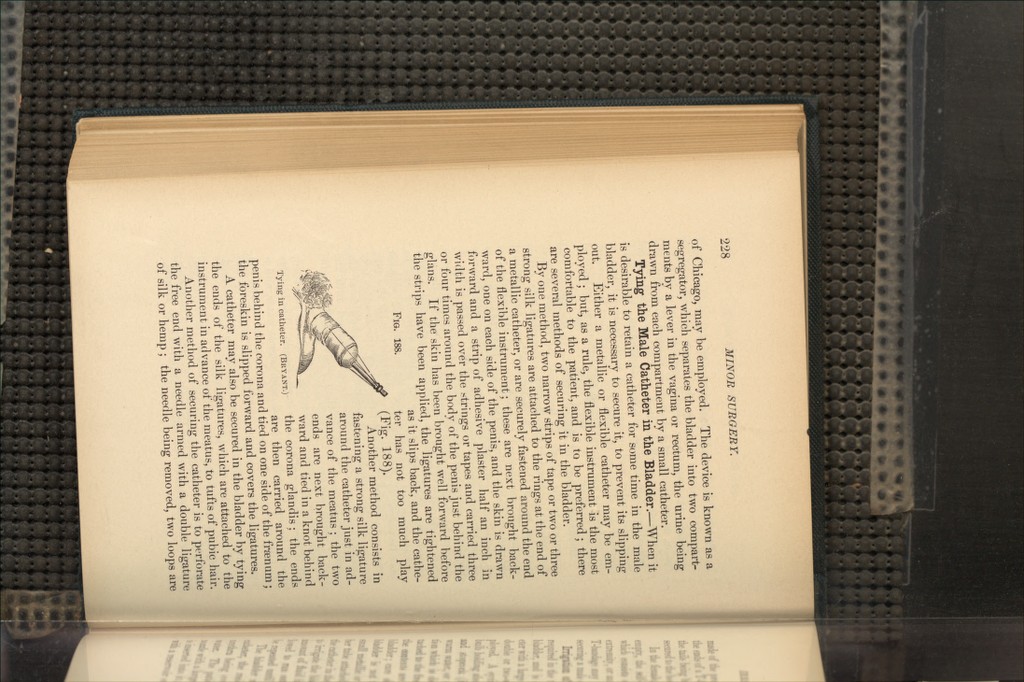
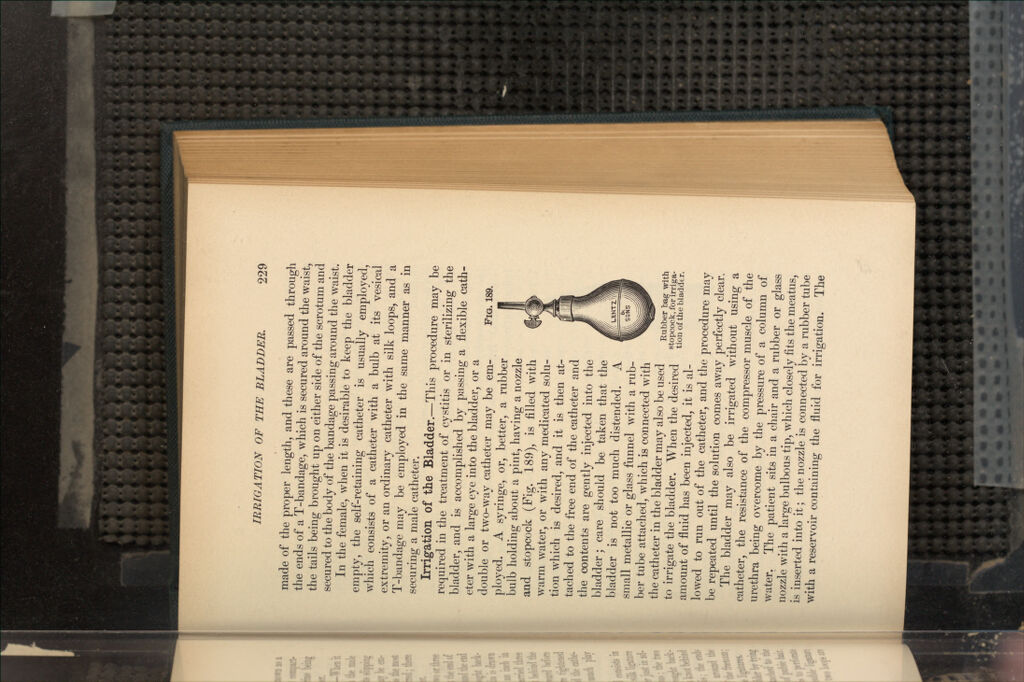
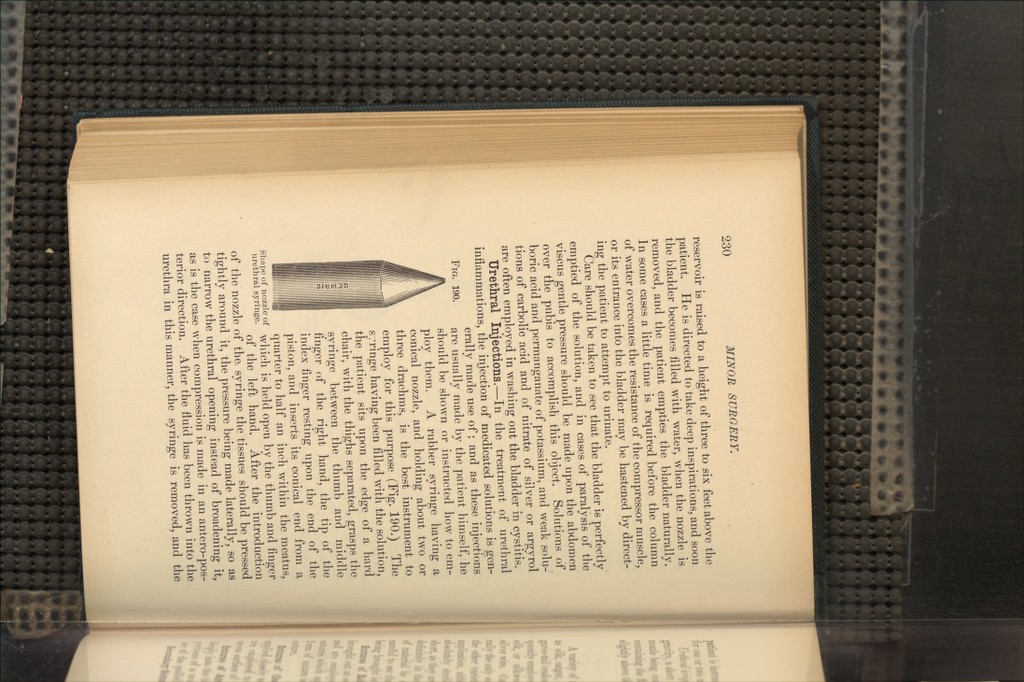
![of Chicago, may be employed. The device is known as a segregator, which separates the bladder into two compart- ments by a lever in the vagina or rectum, the urine being drawn from each compartment by a small catheter. Tying the Male Catheter in the Bladder.—When it is desirable to retain a catheter for some time in the male bladder, it is necessary to secure it, to prevent its slipping out. Either a metallic or flexible catheter may be em- ployed ; but, as a rule, the flexible instrument is the most comfortable to the patient, and is to be preferred; there are several methods of securing it in the bladder. By one method, two narrow strips of tape or two or three strong silk ligatures are attached to the rings at the end of a metallic catheter, or are securely fastened around the end of the flexible instrument; these are next brought back- ward, one on each side of the penis, and the skin is drawn forward and a strip of adhesive plaster half an inch in width is passed over the strings or tapes and carried three or four times around the body of the penis just behind the glans. If the skin has been brought well forward before the strips have been applied, the ligatures are tightened as it slips back, and the cathe- FIG. 188. fer nas nof; £00 mucn p]ay (Fig. 188). Another method consists in fastening a strong silk ligature around the catheter just in ad- vance of the meatus; the two ends are next brought back- ward and tied in a knot behind Tying in catheter. (BRYANT.) the corona glandis : the ends are then carried around the penis behind the corona and tied on one side of the fraenum; the foreskin is slipped forward and covers the ligatures. A catheter may also be secured in the bladder by tying the ends of the silk ligatures, which are attached to the instrument in advance of the meatus, to tufts of pubic hair. Another method of securing the catheter is to perforate the free end with a needle armed with a double ligature of silk or hemp; the needle being removed, two loops are](https://iiif.wellcomecollection.org/image/b20996470_0226.jp2/full/800%2C/0/default.jpg)
 No text description is available for this image
 No text description is available for this image
 No text description is available for this image