On the destruction of elephants by parasites : with remarks on two new species of entozoa and on the so-called earth-eating habits of elephants and horses in India / by T. Spencer Cobbold.
- Thomas Spencer Cobbold
- Date:
- 1875
Licence: Public Domain Mark
Credit: On the destruction of elephants by parasites : with remarks on two new species of entozoa and on the so-called earth-eating habits of elephants and horses in India / by T. Spencer Cobbold. Source: Wellcome Collection.
Provider: This material has been provided by The Royal College of Surgeons of England. The original may be consulted at The Royal College of Surgeons of England.
3/14 page 1
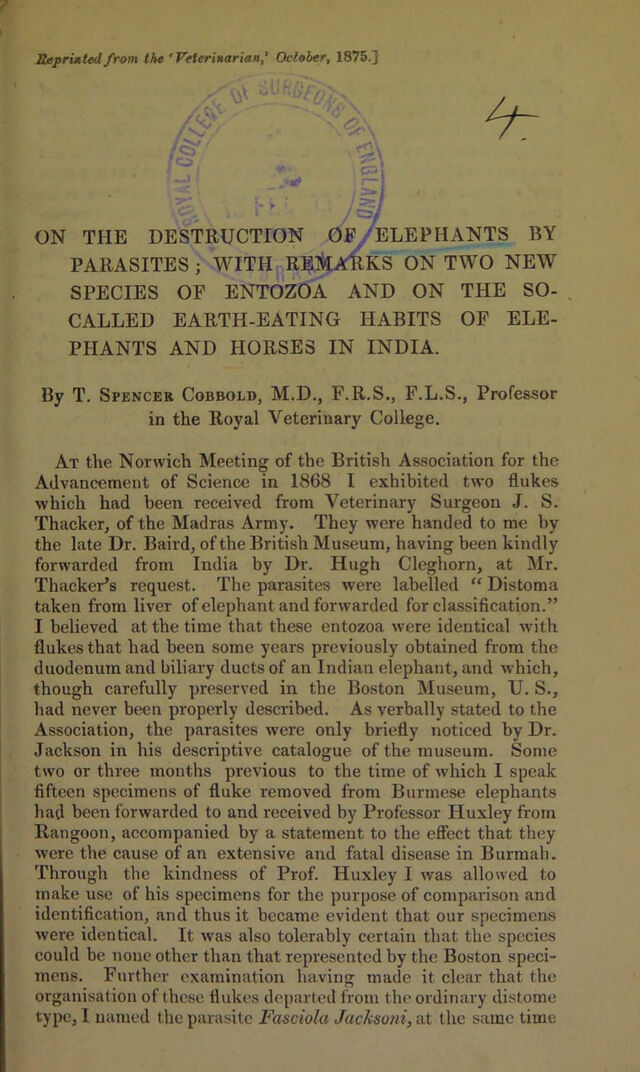
![Reprinted from the 'Veterinarian,’ October, 1875.] \3\ /$•' jfo •• CT'I * .,-.1 f CV\ . 1 * : Asy ON THE DESTRUCTION [R: OF ELEPHANTS BY PARASITES ; WITH REMARKS ON TWO NEW SPECIES OF ENTOZOA AND ON THE SO- CALLED EARTH-EATING HABITS OF ELE- PHANTS AND HORSES IN INDIA. By T. Spencer Cobbold, M.D., F.R.S., F.L.S., Professor in the Royal Veterinary College. At the Norwich Meeting of the British Association for the Advancement of Science in 1868 I exhibited two flukes which had been received from Veterinary Surgeon J. S. Thacker, of the Madras Army. They were handed to me by the late Dr. Baird, of the British Museum, having been kindly forwarded from India by Dr. Hugh Cleghorn, at Mr. Thacker’s request. The parasites were labelled “ Distoma taken from liver of elephant and forwarded for classification.” I believed at the time that these entozoa were identical with flukes that had been some years previously obtained from the duodenum and biliary ducts of an Indian elephant, and which, though carefully preserved in the Boston Museum, U. S., had never been properly described. As verbally stated to the Association, the parasites were only briefly noticed by Dr. Jackson in his descriptive catalogue of the museum. Some two or three months pr-evious to the time of which I speak fifteen specimens of fluke removed from Burmese elephants had been forwarded to and received by Professor Huxley from Rangoon, accompanied by a statement to the effect that they were the cause of an extensive and fatal disease in Burmah. Through the kindness of Prof. Huxley I was allowed to make use of his specimens for the purpose of comparison and identification, and thus it became evident that our specimens were identical. It was also tolerably certain that the species could be none other than that represented by the Boston speci- mens. Further examination having made it clear that the organisation of these flukes departed from the ordinary distome](https://iiif.wellcomecollection.org/image/b22431251_0003.jp2/full/800%2C/0/default.jpg)