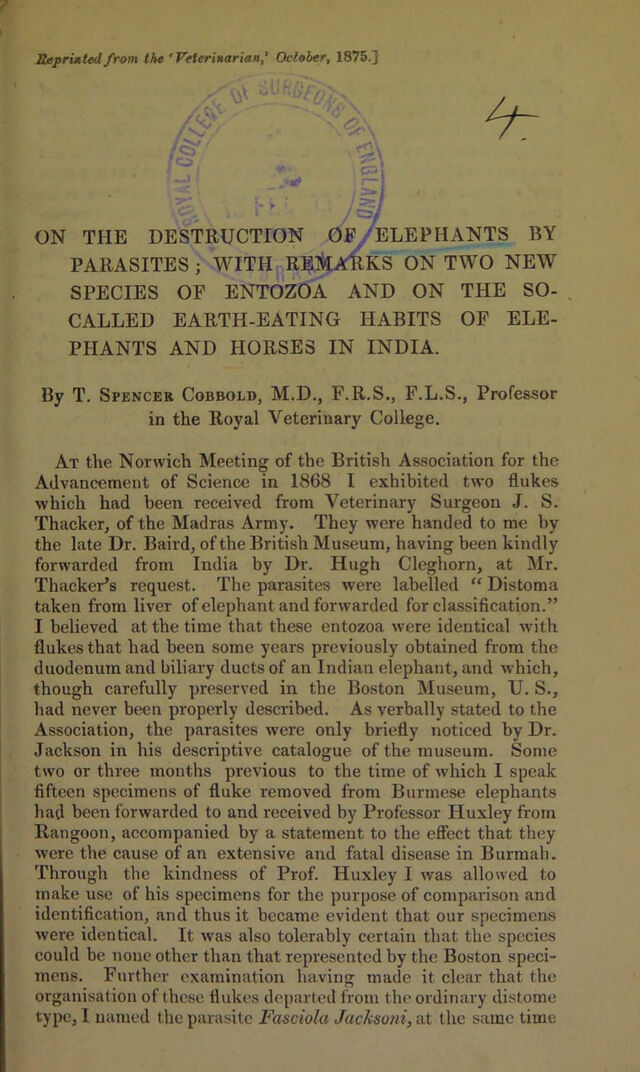
On the destruction of elephants by parasites : with remarks on two new species of entozoa and on the so-called earth-eating habits of elephants and horses in India / by T. Spencer Cobbold.
- Thomas Spencer Cobbold
- Date:
- 1875
Licence: Public Domain Mark
Credit: On the destruction of elephants by parasites : with remarks on two new species of entozoa and on the so-called earth-eating habits of elephants and horses in India / by T. Spencer Cobbold. Source: Wellcome Collection.
Provider: This material has been provided by The Royal College of Surgeons of England. The original may be consulted at The Royal College of Surgeons of England.
4/14 page 2
![offering, as far as I could, a suitable description and figure of the species (Entozoa, Supp., 1869, p. 80). Now, if reference be made to the appendix of the late C. M. Diesing’s Systema Helminthiim, it will be found that Jackson’s statement had not escaped that helminthologist’s notice, though, not having seen any specimens, he was not unnaturally led to place the species amongst the distomes, pi-operly so called. In Diesing’s subse- quently published Revision der Myzelminthcn the species is formally characterised as the Distomum elephantis of Jackson {Sitzungsberichte d. Math.-nat. Cl. d. k. Akad. d. TVissen- schaften, Bd. xxxii, 1858). In my synopsis of the Distomidse, whichappeared in the Journal ofthe Proceedings of tlieLinnean Society for 1861,1 also placed this form amongst the distomes, but I did not consider it to be a doubtful form as Diesing had done (P. L. S., “ Zoology,” vol. v, p. 9). So far as I am aware these references exhaust the literature of the subject up to the time of the issue of my Manual in 1873, where at ]). 13 the fluke in question is .again briefly noticed. I may mention that several of Prof. Huxley’s specimens were placed in the hands of Prof. Flower, Conservator of the Museum of the Royal College of Surgeons, under whose direction six of the flukes were selected, mounted, and added to the rich entozoological department of the Hunterian collection. Interesting as the above facts are to the helminthologist, I should not introduce the subject into the pages of the Veterinarian were I not in possession of additional facts, tending both to confirm the statements originally communi- cated to Professor Huxley and to increase our knowledge of fluke diseases in general, as well as of the rot as it affects elephants in particular. Moreover, so rapid are the strides of helminthology in reference to the correct understanding of epidemics involving both man and beast that, work as one may, it is almost im- possible to do justice to the multitude of novel facts that are weekly, I might almost say daily, presented to our notice. Throughout the East, especially in India, members of the medical and veterinary professions, and also army officers, to judge by their frequent contributions, seem to be much more impressed with the importance of a thorough know- ledge of parasites than do some of those who are placed in the van of the same professions at home. About the middle of June last I received an interesting letter from Lieutenant-Colonel Hawkes, of the Madras Staff Corps, dated Secunderabad, the 12th of May, 1875, and in re- ference to the subject before us he writes as follows :—“ My attention has been recently directed to a very unusual mor-](https://iiif.wellcomecollection.org/image/b22431251_0004.jp2/full/800%2C/0/default.jpg)