Contributions to the anatomy of anthropoid apes / by Frank E. Beddard.
- Frank Evers Beddard
- Date:
- 1893
Licence: Public Domain Mark
Credit: Contributions to the anatomy of anthropoid apes / by Frank E. Beddard. Source: Wellcome Collection.
140/246 page 284
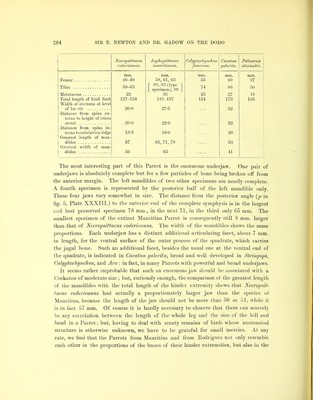
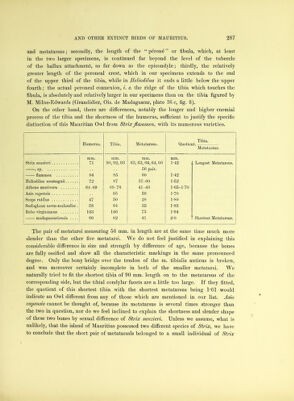
![Necropsittacus rodericanus. Lophopsittacus mauritianus. Calyptorhynchus funereus. Cacatua galerita. Palceornis alexandri. mm. mm. mm. mm. mm. Femur 46-49 58, 61, 63 55 60 37 Tibia 59-63 | 88, 93 (type 1 \ specimen), 99 j 74 86 50 Metatarsus 22 35 25 27 18 Total length of hind limb Width of sternum at level 127-134 181-197 154 173 105 of 1st rib Distance from spina ex- terna to height of crista 20-0 27-5 32 sterni Distance from spina in- 20-0 22-0 32 terna to subclavian ridge Greatest length of man- 13-5 16-0 20 dibles Greatest width of man- 57 65, 71, 78 53 dibles 50 65 41 The most interesting part of this Parrot is the enormous underjaw. One pair of underjaws is abso]utely complete but for a few particles of bone being broken off from the anterior margin. The left mandibles of two other specimens are nearly complete. A fourth specimen is represented by the posterior half of the left mandible only. These four jaws vary somewhat in size. The distance from the posterior angle (p in fig. 5, Plate XXXIII.) to the anterior end of the complete symphysis is in the largest and best preserved specimen 78 mm., in the next 71, in the third only 65 mm. The smallest specimen of the extinct Mauritian Parrot is consequently still 8 mm. larger than that of Necropsittacus rodericanus. The width of the mandibles shows the same proportions. Each underjaw has a distinct additional articulating facet, about 7 mm. in length, for the ventral surface of the outer process of the quadrate, which carries the jugal bone. Such an additional facet, besides the usual one at the ventral end of the quadrate, is indicated in Cacatua galerita, broad and well developed in String ops, Calyptorhynchus, and Ara : in fact, in many Parrots with powerful and broad underjaws. It seems rather improbable that such an enormous jaw should be associated with a Cockatoo of moderate size; but, curiously enough, the comparison of the greatest length of the mandibles with the total length of the hinder extremity shows that Necropsit- tacus rodericanus had actually a proportionately larger jaw than the species of Mauritius, because the length of the jaw should not be more than 50 or 51, while it is in fact 57 mm. Of course it is hardly necessary to observe that there can scarcely be any correlation between the length of the whole leg and the size of the bill and head in a Parrot; but, having to deal with scanty remains of birds whose anatomical structure is otherwise unknown, we have to be grateful for small mercies. At any rate, we find that the Parrots from Mauritius and from Rodriguez not only resemble each other in the proportions of the bones of their hinder extremities, but also in the](https://iiif.wellcomecollection.org/image/b28141386_0140.jp2/full/800%2C/0/default.jpg)