Contributions to the anatomy of anthropoid apes / by Frank E. Beddard.
- Frank Evers Beddard
- Date:
- 1893
Licence: Public Domain Mark
Credit: Contributions to the anatomy of anthropoid apes / by Frank E. Beddard. Source: Wellcome Collection.
71/246 page 223
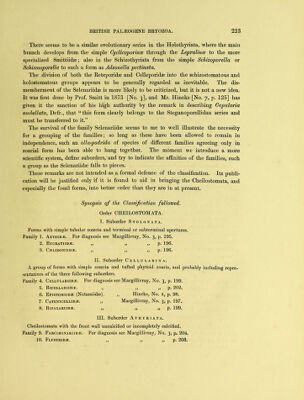
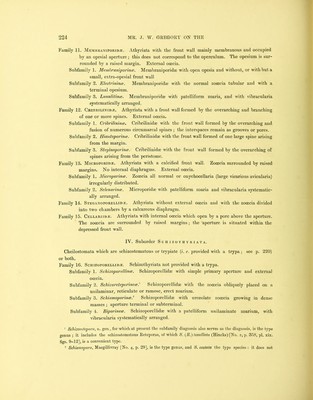
![There seems to be a similar evolutionary series in the Holothyriata, where the main branch develops from the simple Cyclicoporince through the Lepralince to the more specialized Smittiidse; also in the Schizothyriata from the simple Schizoporella or Schismoporella to such a form as Adeonella pectinata. The division of both the Reteporidse and Celleporidse into the schizostomatous and holostomatous groups appears to be generally regarded as inevitable. The dis- memberment of the Selenariidse is more likely to be criticized, but it is not a new idea. It was first done by Prof. Smitt in 1873 [No. 3], and Mr. Hincks [No. 7, p. 125] has given it the sanction of his high authority by the remark in describing Cupularia umbellata, Defr., that “ this form clearly belongs to the Steganoporellidan series and must be transferred to it.” The survival of the family Selenariidse seems to me to well illustrate the necessity for a grouping of the families; so long as these have been allowed to remain in independence, such an olla-podrida of species of different families agreeing only in zoarial form has been able to hang together. The moment we introduce a more scientific system, define suborders, and try to indicate the affinities of the families, such a group as the Selenariidse falls to pieces. These remarks are not intended as a formal defence of the classification. Its publi- cation will be justified only if it is found to aid in bringing the Cheilostomata, and especially the fossil forms, into better order than they are in at present. Synopsis of the Classification followed. Order CHEILOSTOMATA. I. Suborder Stolonata. Forms with simple tubular zooecia and terminal or subterminal apertures. Family 1. Aeteidaj. For diagnosis see Macgillivray, No. 3, p. 195. 2. Eucratiidas. „ „ „ p. 196. 3. Chlidoniii)*. „ „ „ p. 196. II. Suborder Cellularina. A group of forms with simple zooecia and tufted phytoid zoaria, and probably including repre- sentatives of the three following suborders. Family 4. Cellueariib.e. For diagnosis see Macgillivray, No. 3, p. 199. 5. Bicellariid*. „ ,, „ p. 202. 6. ErisTOMiim® (Notamiidse). „ Hincks, No. 2, p. 98. 7. Catenicellid^e. „ Macgillivray, No. 3, p. 197. 8. BlFAXARIIDiE. „ „ „ p. 199. III. Suborder Athyriata. Cheilostomata with the front wall uncalcified or incompletely calcified. Family 9. Farciminariidas. For diagnosis see Macgillivray, No. 3, p. 204. 10. Flustridas. „ „ „ p. 203.](https://iiif.wellcomecollection.org/image/b28141386_0071.jp2/full/800%2C/0/default.jpg)