Contributions to the anatomy of anthropoid apes / by Frank E. Beddard.
- Frank Evers Beddard
- Date:
- 1893
Licence: Public Domain Mark
Credit: Contributions to the anatomy of anthropoid apes / by Frank E. Beddard. Source: Wellcome Collection.
72/246 page 224
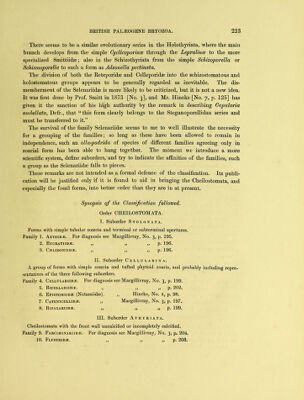
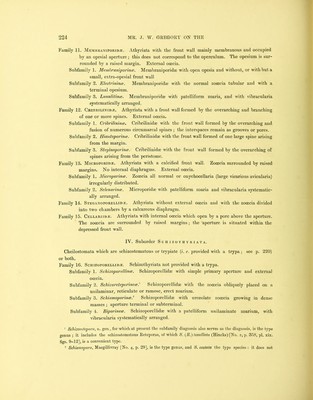
![Family 11. Mem hranti porid a:. Athyriata with the front wall mainly membranous and occupied by an opesial aperture; this does not correspond to the operculum. The opesium is sur- rounded by a raised margin. External ooecia. Subfamily 1. Membraniporince. Membraniporidse with open opesia and without, or with but a small, extra-opesial front wall Subfamily 2. Electi'inina. Membraniporidse with the normal zooecia tubular and with a terminal opesium. Subfamily 3. Lunulitinee. Membraniporidse with patelliform zoaria, and with vibracularia systematically arranged. Family 12. Cribrilinidse. Athyriata with a front wall formed by the overarching and branching of one or more spines. External ooecia. Subfamily 1. Cribrilinince. Cribrilinidse with the front wall formed by the overarching and fusion of numerous circumareal spines; the interspaces remain as grooves or pores. Subfamily 2. Hiantoporince. Cribrilinidse with the front wall formed of one large spine arising from the margin. Subfamily 3. Steginoporirue. Cribrilinidse with the front wall formed by the overarching of spines arising from the peristome. Family 13. Microporida:. Athyriata with a calcified front wall. Zooecia surrounded by raised margins. No internal diaphragms. External ooecia. Subfamily 1. Microporince, Zooecia all normal or onychocellaria (large vicarious avicularia) irregularly distributed. Subfamily 2. Selenurince. Microporidse with patelliform zoaria and vibracularia systematic- ally arranged. Family 14. Steganoporellidm.. Athyriata without external ooecia and with the zooecia divided into two chambers by a calcareous diaphragm. Family 15. Cellariidve. Athyriata with internal ooecia which open by a pore above the aperture. The zooecia are surrounded by raised margins; the aperture is situated within the depressed front wall. IV. Suborder Schizothyriata. Cheilostomata which are schizostomatous or trypiate (i. e. provided with a trypa ; see p. 220) or both. Family 16. Schizoporellidse. Schizothyriata not provided with a trypa. Subfamily 1. Schizoporellince. Schizoporellidse with simple primary aperture and external ooecia. Subfamily 2. Schizoreteporinea.l Schizoporellidse with the zooecia obliquely placed on a unilaminar, reticulate or ramose, erect zoarium. Subfamily 3. Schismoporince2 3 Schizoporellidse with urceolate zooecia growing in dense masses ; aperture terminal or subterminal. Subfamily 4. Biporinete. Schizoporellidse with a patelliform unilaminate zoarium, with vibracularia systematically arranged. 1 Schizoretepora, n. gen., for which at present the subfamily diagnosis also serves as the diagnosis, is the type genus ; it includes the schizostomatous Reteporas, of which S. (R.) fessellata (Hincks) [No. 2, p. 358, pi. xix. figs. 9-12], is a convenient type. 3 Schismopora, Macgillivray [No. 4, p. 29], is the type genus, and S. costata the type species : it does not](https://iiif.wellcomecollection.org/image/b28141386_0072.jp2/full/800%2C/0/default.jpg)