Contributions to the anatomy of anthropoid apes / by Frank E. Beddard.
- Frank Evers Beddard
- Date:
- 1893
Licence: Public Domain Mark
Credit: Contributions to the anatomy of anthropoid apes / by Frank E. Beddard. Source: Wellcome Collection.
78/246 page 230
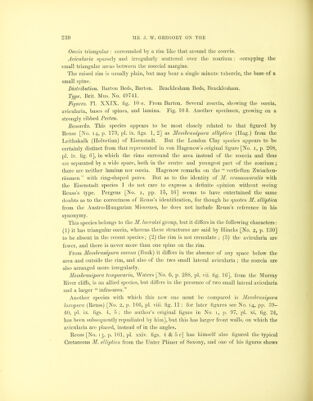
![Ocecia triangular: surrounded by a rim like that around the zocecia. Avicularia sparsely and irregularly scattered over the zoarium: occupying the small triangular areas between the zocecial margins. The raised rim is usually plain, but may bear a single minute tubercle, the base of a small spine. Distribution. Barton Beds, Barton. Bracklesham Beds, Bracklesham. Type. Brit. Mus. No. 49741. Figures. PI. XXIX. fig. 10 a. From Barton. Several zocecia, showing the ooecia, avicularia, bases of spines, and lamina. Fig. 10 b. Another specimen, growing on a strongly ribbed Pecten. Remarks. This species appears to be most closely related to that figured by Beuss [No. 14, p. 179, pi. ix. figs. 1, 2] as Membranipora elliptica (Hag.) from the Leitliakalk (Helvetian) of Eisenstadt. But the London Clay species appears to be certainly distinct from that represented in von Hagenow’s original figure [No. 1, p. 268, pi. iv. fig. 6], in which the rims surround the area instead of the zocecia and thus are separated by a wide space, both in the centre and youngest part of the zoarium ; there are neither laminae nor ooecia. Hagenow remarks on the “ vertieften Zwischen- raumen ” with ring-shaped pores. But as to the identity of M. crassomuralis with the Eisenstadt species I do not care to express a definite opinion without seeing Beuss’s type. Pergens [No. 1, pp. 15, 16] seems to have entertained the same doubts as to the correctness of Beuss’s identification, for though he quotes M. elliptica from the Austro-Hungarian Miocenes, he does not include Beuss’s reference in his synonymy. This species belongs to the M. laeroixi group, but it differs in the following characters: (1) it has triangular ooecia, whereas these structures are said by Hincks [No. 2, p. 130] to be absent in the recent species; (2) the rim is not crenulate ; (3) the avicularia are fewer, and there is never more than one spine on the rim. From Membranipora eocena (Busk) it differs in the absence of any space below the area and outside the rim, and also of the two small lateral avicularia ; the zocecia are also arranged more irregularly. Membranipora temporaria, Waters [No. 6, p. 288, pi. vii. fig. 16], from the Murray Biver cliffs, is an allied species, but differs in the presence of two small lateral avicularia and a larger “ infra-area.” Another species with which this new one must be compared is Membranipora loxopora (Beuss) [No. 2, p. 166, pi. viii. fig. 11 : for later figures see No. 14, pp. 39- 40, pi. ix. figs. 4, 5 ; the author’s original figure in No. 1, p. 97, pi. xi. fig. 24, has been subsequently repudiated by him], but this has larger front walls, on which the avicularia are placed, instead of in the angles. Beuss [No. 13, p. 101, pi. xxiv. figs. 4 & 5 c] has himself also figured the typical Cretaceous M. elliptica from the Unter Planer of Saxony, and one of his figures shows](https://iiif.wellcomecollection.org/image/b28141386_0078.jp2/full/800%2C/0/default.jpg)