Atonia gastrica (abdominal relaxation) / by Achilles Rose, M.D. and Robert Coleman Kemp, M.D.
- Achilles Rose
- Date:
- 1905
Licence: Public Domain Mark
Credit: Atonia gastrica (abdominal relaxation) / by Achilles Rose, M.D. and Robert Coleman Kemp, M.D. Source: Wellcome Collection.
Provider: This material has been provided by the Augustus C. Long Health Sciences Library at Columbia University and Columbia University Libraries/Information Services, through the Medical Heritage Library. The original may be consulted at the the Augustus C. Long Health Sciences Library at Columbia University and Columbia University.
205/236 (page 177)
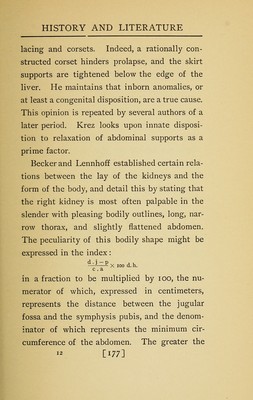
![lacing and corsets. Indeed, a rationally con- structed corset hinders prolapse, and the skirt supports are tightened below the edge of the liver. He maintains that inborn anomalies, or at least a congenital disposition, are a true cause. This opinion is repeated by several authors of a later period. Krez looks upon innate disposi- tion to relaxation of abdominal supports as a prime factor. Becker and Lennhoff established certain rela- tions between the lay of the kidneys and the form of the body, and detail this by stating that the right kidney is most often palpable in the slender with pleasing bodily outlines, long, nar- row thorax, and slightly flattened abdomen. The peculiarity of this bodily shape might be expressed in the index: ^^i^xiood.h. c . a in a fraction to be multiplied by lOO, the nu- merator of which, expressed in centimeters, represents the distance between the jugular fossa and the symphysis pubis, and the denom- inator of which represents the minimum cir- cumference of the abdomen. The greater the 12 [177]](https://iiif.wellcomecollection.org/image/b21209030_0205.jp2/full/800%2C/0/default.jpg)