Atonia gastrica (abdominal relaxation) / by Achilles Rose, M.D. and Robert Coleman Kemp, M.D.
- Achilles Rose
- Date:
- 1905
Licence: Public Domain Mark
Credit: Atonia gastrica (abdominal relaxation) / by Achilles Rose, M.D. and Robert Coleman Kemp, M.D. Source: Wellcome Collection.
Provider: This material has been provided by the Augustus C. Long Health Sciences Library at Columbia University and Columbia University Libraries/Information Services, through the Medical Heritage Library. The original may be consulted at the the Augustus C. Long Health Sciences Library at Columbia University and Columbia University.
206/236 (page 178)
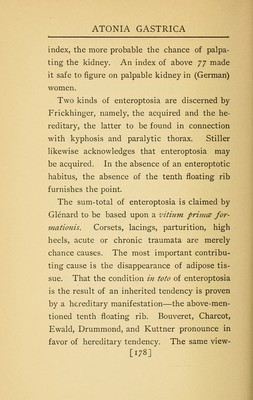
![index, the more probable the chance of palpa- ting the kidney. An index of above JJ made it safe to figure on palpable kidney in (German) women. Two kinds of enteroptosia are discerned by Frickhinger, namely, the acquired and the he- reditary, the latter to be found in connection with kyphosis and paralytic thorax. Stiller likewise acknowledges that enteroptosia may be acquired. In the absence of an enteroptotic habitus, the absence of the tenth floating rib furnishes the point. The sum-total of enteroptosia is claimed by Glenard to be based upon a vitumi primes for- viationis. Corsets, lacings, parturition, high heels, acute or chronic traumata are merely chance causes. The most important contribu- ting cause is the disappearance of adipose tis- sue. That the condition in toto of enteroptosia is the result of an inherited tendency is proven by a hereditary manifestation—the above-men- tioned tenth floating rib. Bouveret, Charcot, Ewald, Drummond, and Kuttner pronounce in favor of hereditary tendency. The same view- [178]](https://iiif.wellcomecollection.org/image/b21209030_0206.jp2/full/800%2C/0/default.jpg)