Atonia gastrica (abdominal relaxation) / by Achilles Rose, M.D. and Robert Coleman Kemp, M.D.
- Achilles Rose
- Date:
- 1905
Licence: Public Domain Mark
Credit: Atonia gastrica (abdominal relaxation) / by Achilles Rose, M.D. and Robert Coleman Kemp, M.D. Source: Wellcome Collection.
Provider: This material has been provided by the Augustus C. Long Health Sciences Library at Columbia University and Columbia University Libraries/Information Services, through the Medical Heritage Library. The original may be consulted at the the Augustus C. Long Health Sciences Library at Columbia University and Columbia University.
229/236 page 201
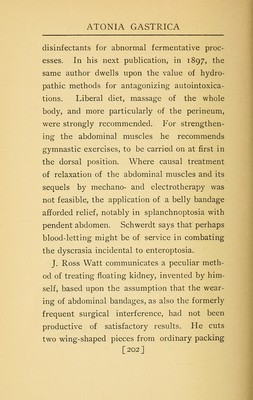
![all times the nervous system is entitled to the strictest observation and treatment. Aufrecht recommends Gl^nard's hypogastric belt. By means of this belt a diminution of abdominal space in an upward and downward direction is produced. This causes limitation of mobility in descended organs, checks their to-and-fro move- ments, and lessens the stretching of suspensory ligaments, notably those of the kidney and stom- ach. Thus circulatory conditions are vastly improved and the nervous reflexes caused by ligamentary traction are obviated. Glenard's belt is not a belly bandage in the properly ac- cepted sense of that term. All so-called abdom- inal bandages are, according to Aufrecht, abso- lutely worthless in the treatment of gastroptosia. In his essay of 1896 Schwerdt defines the aims of therapy in enteroptosia: the raising of intraabdominal tension pressure, the lessening of contact pressure, and removal of gaseous distention pressure. Accordingly, the therapy seems to suggest massage, gymnastic exercises, belly bandages, regulation of the bowels, inter- diction of fattening diet, and employment of [201]](https://iiif.wellcomecollection.org/image/b21209030_0229.jp2/full/800%2C/0/default.jpg)



 No text description is available for this image
 No text description is available for this image
 No text description is available for this image