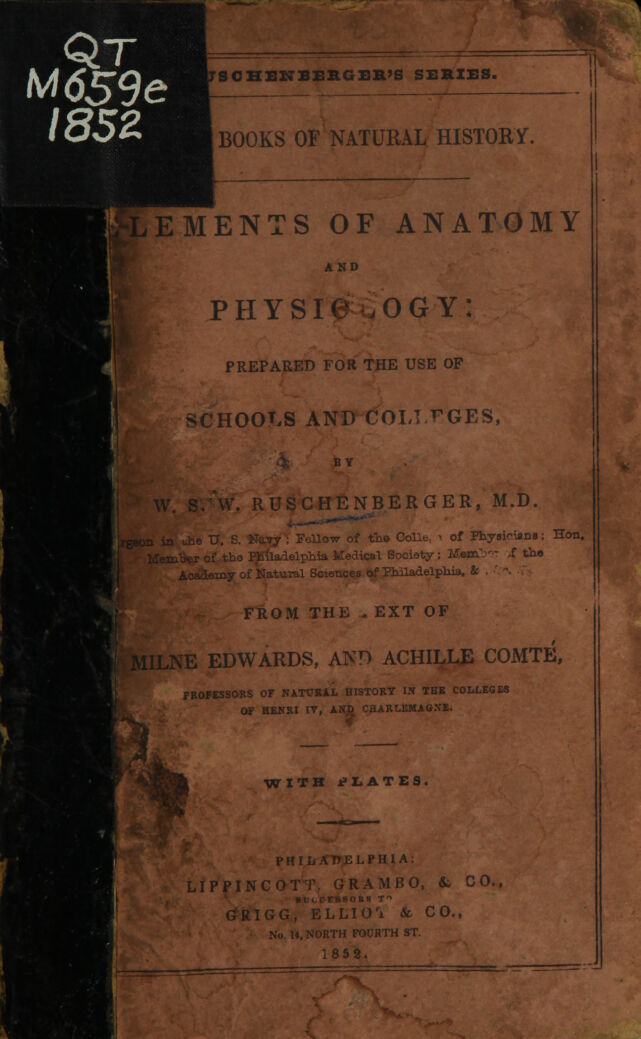
Elements of anatomy and physiology : prepared for the use of schools and colleges / by W. S. W. Ruschenberger ; from the text of Milne Edwards and Achille Comté.
- Henri Milne-Edwards
- Date:
- 1852
Licence: Public Domain Mark
Credit: Elements of anatomy and physiology : prepared for the use of schools and colleges / by W. S. W. Ruschenberger ; from the text of Milne Edwards and Achille Comté. Source: Wellcome Collection.
Provider: This material has been provided by the National Library of Medicine (U.S.), through the Medical Heritage Library. The original may be consulted at the National Library of Medicine (U.S.)
27/144
![OF TE1E BLOOD. 13. The Blood is the nutritive liquid of animals. 14. It is this liquid which maintains life in the organs, and furnishes them with the materials of which they are composed. 15. The blood is the source of all the humors formed in the body ; as the saliva, tears, bile, &c. 1G. In man, and all animals resembling him in organization, the blood is red. In a great number of others, it is colourless, or of a slight yellow or lilach tint. 17. The animals which have red blood, are the mammalia, birds, reptiles, fishes,and certain worms called Annelides. 18. The animals with white blood, are the insects, theArach- nides. (that is spiders, and other animals resembling them,) the Crustacea, (a class of animals composed of crabs, lobsters, &c.) the mollusca, (or animals resembling snails and oysters) and some others. 19. It is a vulgar error to suppose that flies have red blood in the head: when one of these animals is crushed we see, it is true, an effusion of reddish liquid, but this is not blood, and comes from the eyes of these little beings, whose blood, like that of all insects, is white. 20 Blood is more or less thick and opaque. When examined by a microscope we perceive that it is formed of two distinct parts, namely :— 1st. Of a yellowish, transparent liquid, called Sert/m. 2nd Of a great number of solid particles of extremely small size which swim in the serum, and which are called the global, s of !ht blood. 21. To these globules the blood is indebted for its red color. They are flattened and have a considerable resemblance to small ; of money slightly drilled out in the middle (page SO.Jiy. 2.) Their form and size vary in different animals. 1 ?,. \\ hat is blood ? 11. V\ hat is the use of the blood? 15. What is the blood the source of? 1G. What is the color of the blood ? 17. What animals have red blood? Is What animals have white blood ? ]!). Have flies led blood % 20. Is the blood transparent? Of how many parts is it composed ? What are these parts called? What is serum? What are the globules of the blood ? 21. Upon what docs the red color of the blood depend? What is the form of the globules? Are the size and form of the globules the same in all ani- mals ? 3](https://iiif.wellcomecollection.org/image/b21141411_0027.jp2/full/800%2C/0/default.jpg)


 No text description is available for this image
 No text description is available for this image
 No text description is available for this image