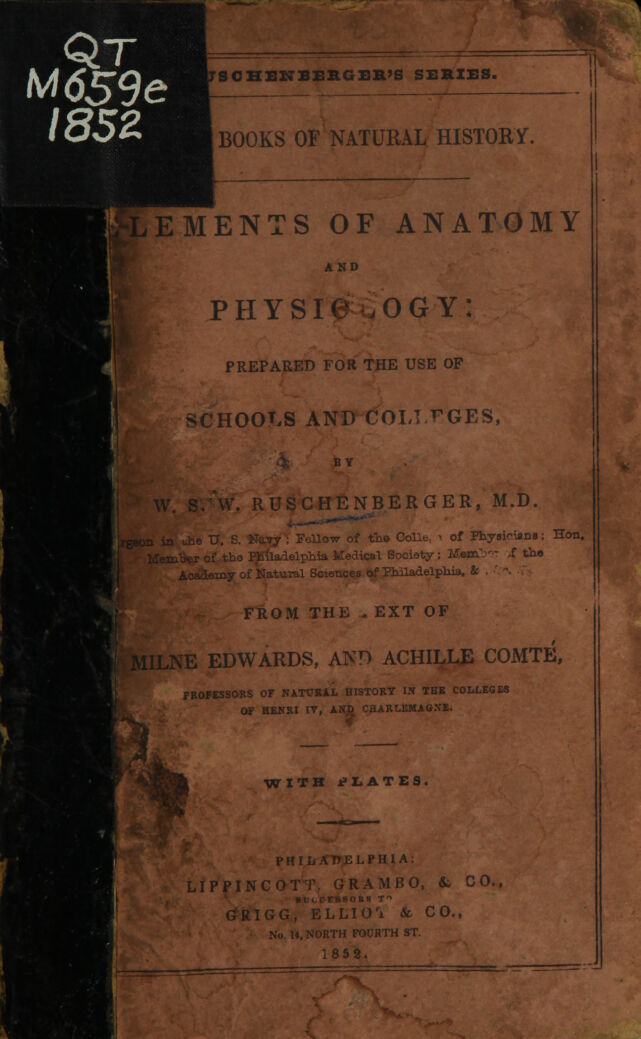
Elements of anatomy and physiology : prepared for the use of schools and colleges / by W. S. W. Ruschenberger ; from the text of Milne Edwards and Achille Comté.
- Henri Milne-Edwards
- Date:
- 1852
Licence: Public Domain Mark
Credit: Elements of anatomy and physiology : prepared for the use of schools and colleges / by W. S. W. Ruschenberger ; from the text of Milne Edwards and Achille Comté. Source: Wellcome Collection.
Provider: This material has been provided by the National Library of Medicine (U.S.), through the Medical Heritage Library. The original may be consulted at the National Library of Medicine (U.S.)
28/144
![Fig. 3. t 22. In man, the dog, the horse, and all other ani- mals of the class of mammalia, the globules of the blood are circular, {a. h.) 23. In birds, reptiles, and fishes, the globules are of an oval form, (c.) 24. They are smallest in the mammalia, and largest in reptiles and fishes. 25. The blood of the mammalia and birds contains the greatest number of globules. 2(3. In animals with white blood, the globules are colourless, generally circular, and very few in number. [ When these globules are carefully examined, with a powerful microscope, it is seen that each one is composed of two distinct parts, and that they consist of a sort of bladder or membranous sack, in the middle of which there is found a spheroidal corpus- cule,—(a diminutive body.) [ Under ordinary circumstances, this bladder is flattened, and forms, around a central nucleus, a circular border, of greater or less depth, so that, as a whole, it presents the appearance of a disk, (a.) swelled or bulged in the middle. The external envelope of the globules consists of a 3 sort of jelly, which is of a more or less beautiful red colour, and is easily divided: it is to the presence of these vesicles, (little bladders,) that the blood owes its colour. The central nucleus of the globules is more consistant, and is not coloured.] 27. In its ordinary state, the blood is always fluid, and the globules swim freely in the serum; but when drawn from the vessels which contain it, and left to itself, it is not slow to con- geal, and to present the phenomenon of coagulation. * Fig. 2.—a, blood of a man,—b, blood of a sheep,—c, blood of a sparrow. These globules are magnified one thousand times in diameter. t Fig. 3.—a, globule of the blood of a frog, magnified about seven hun- dred times, and seen in profile : b, the same globule seen in front ; the envelope is torn so as to show the central nucleus. 22. What is the form of the globules in the mammalia? 23. In what class of animals are the globules oval? 24. In what animals are they smallest? In wrjat animals largest? 25. What animals have the greatest proportion of globules in the blood? 2G. What is the form and colour of the globules in white blooded animals? 27. What is the ordinary state of the blood? When drawn from the vessels, and left to itself, what takes place ?](https://iiif.wellcomecollection.org/image/b21141411_0028.jp2/full/800%2C/0/default.jpg)


 No text description is available for this image
 No text description is available for this image
 No text description is available for this image