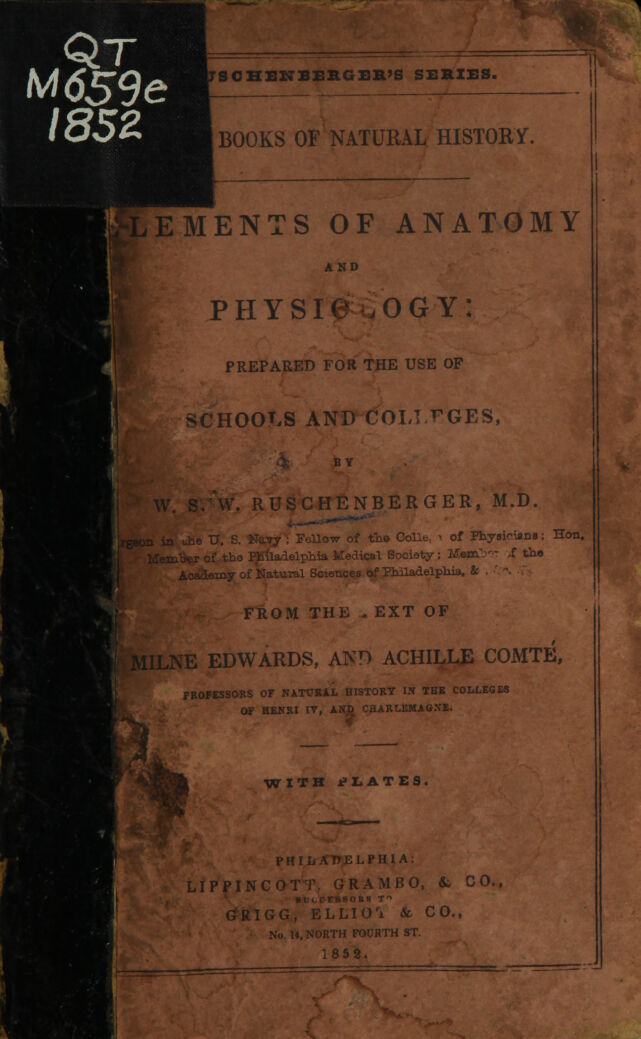
Elements of anatomy and physiology : prepared for the use of schools and colleges / by W. S. W. Ruschenberger ; from the text of Milne Edwards and Achille Comté.
- Henri Milne-Edwards
- Date:
- 1852
Licence: Public Domain Mark
Credit: Elements of anatomy and physiology : prepared for the use of schools and colleges / by W. S. W. Ruschenberger ; from the text of Milne Edwards and Achille Comté. Source: Wellcome Collection.
Provider: This material has been provided by the National Library of Medicine (U.S.), through the Medical Heritage Library. The original may be consulted at the National Library of Medicine (U.S.)
29/144
![23. When blood coagulates, the globules unite themselves to- gether in a mass, and little by little separate from the serum, to form a clot more or less solid. [Chemistry teaches us, that in man, 100 parts of blood, contain about 66 parts of water, from 6 to 7 hundredths of albumen, (1), from 14 to 15 hundredths of fibrin, (2), and colouring matter, some thousandtns of fatty matters* of several salts, and traces of the peroxide of iron. ■ Under ordinary circumstances, we cannot discover in the blood, those substances which are found in the different humors, formed at its expense ; but if we arrest the action of those organs that are charged with secreting these humors, we then find in the blood, the matters in question. We must therefore conclude that they always exist in it, but in quantities too small to be appreciated by our methods of analysis; and that the organs just alluded to, do not form them, but separate them from the blood in proportion as they are presented.] 23. The blood contains all the materials necessary to the re- paration and growth of the organs; consequently, it furnishes to all parts the matter, of which they are in need for their nourish- ment, and also imparts the excitement necessary to the main- tenance of life. 30. To appreciate fully the importance of the office filled by the blood in the bodies of living animals, it is only necessary to bleed one, and observe the effects of the operation. 31. When the flow of blood continues for a long time, the animal falls into syncope, (fainting,) and if the bleeding be not arrested, all motion ceases in a few moments; respiration is stopped, and life is no longer manifest by external sign. If the animal be left in this condition, reality soon takes the place of ap- pearance, and death speedily follows. But if we inject into his veins, blood similar to that which he has lost, we see with astonish- ment this semblance of a corpse return to life ; in proportion as ad- (1.) Albumen, is a kind of matter that enters into the composition of most of the organic tissues of animals, and almost, by itself constitutes the white of eggs. It can be di-solved in water, but by the action of beat, it solidifies* and becomes insoluble. (-2.) Fibrin, is the basis of muscular flesh. It can be separated from b'ood by beating it with rods before it coagulates; the fibrin adheres to the rods in the form of very elastic whitish filaments. 23. When blood coagulates what takes place? 29. What does the blood contain? What other use has the blood besides that of nourishing the organs ? 30. ilow can you show the importance of the blood to living animals 31. How is an animal effected by Weeding ? What is the effect of inject- iiiT blind into the veins of an animal that has been exhausted by bleeding?](https://iiif.wellcomecollection.org/image/b21141411_0029.jp2/full/800%2C/0/default.jpg)


 No text description is available for this image
 No text description is available for this image
 No text description is available for this image