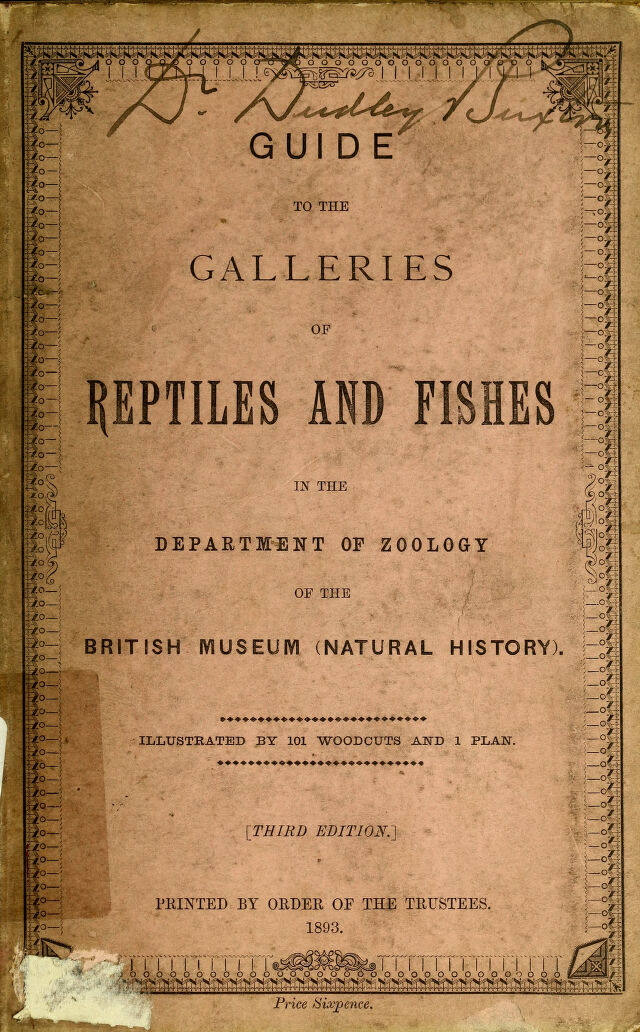
Guide to the galleries of reptiles and fishes in the Department of zoology of the British museum (Natural history) : Illustrated by 101 woodcuts and 1 plan.
- British Museum (Natural History). Department of Zoology.
- Date:
- 1893
Licence: Public Domain Mark
Credit: Guide to the galleries of reptiles and fishes in the Department of zoology of the British museum (Natural history) : Illustrated by 101 woodcuts and 1 plan. Source: Wellcome Collection.
20/134 page 10
![passing the whole of their existence under ground in loose soil, sand, or ant-heaps. The skin is not protected by either scales or scutes, but divided by circular and longitudinal folds into quad- rangular segments arranged in rings. The colour of the skin is either whitish, reddish, or greyish, sometimes marbled with black. Legs are absent (with the exception of the genus Chirotes, in which a pair of very short fore legs are developed). The head and tail are both short; and the superficial similarity of the two extremities in some of the species has led to the belief that they could progress backwards and forwards with equal facility; they are often described as Two-headed Snakes.^^ Their eyes are quite rudimentary, hidden below the skin ; ear-openings are likewise absent. The Amphisbsenians are inhabitants of hot countries—Africa, America, and the countries round the Mediterranean. About 50 diflPerent species are known. [Case 18.] Lizards proper (LacertidcB) are confined to the Old World, and found in Europe, Asia, and Africa. They seldom reach a length of eighteen inches [Lacerta ocellata) ; they feed on small animals, insects and worms being the principal diet, but a few, like the small Lizards of Madeira, have taken to a vegetable diet, and cause some injury to grapes and other soft fruit. The Common British Lizard is Lacerta vivipara; the Sand Lizard [L. agilis) and Green Lizard (L. viridis) being more locally distributed in the Southern Counties and the Channel Islands, but very abundant in various parts of the continent of Europe. [Case 18.] The Angmdce include limbed as well as limbless forms; of the latter the Slowworm or Blindworm [Anguis fragilis), common in Great Britain, is the best known. The Glass Snake, or Shelto- pusik [Pseudopus pallasii or OpMsaurus apus), common in South- eastern Europe and Western Asia, is another example. [Case 18.] The Scincidce or Skinks, recognizable by their round imbricate scales, also include forms in wLich the limbs are rudimentary or absent. The largest forms of this family are Australian, as Tiliqua gig as and nigrolutea, and Trachydosaurus, the last remarkable for their rough scales and short tail, somewhat re- sembling the cone of a fir-tree. A very curiously shaped form, also from Australia, is Egernia stokesii, with its short conical tail armed with dagger-pointed spinous scales.](https://iiif.wellcomecollection.org/image/b28104663_0020.jp2/full/800%2C/0/default.jpg)