Licence: Public Domain Mark
Credit: The modern rack; papers on vivisection. Source: Wellcome Collection.
Provider: This material has been provided by the Augustus C. Long Health Sciences Library at Columbia University and Columbia University Libraries/Information Services, through the Medical Heritage Library. The original may be consulted at the the Augustus C. Long Health Sciences Library at Columbia University and Columbia University.
241/284 (page 231)
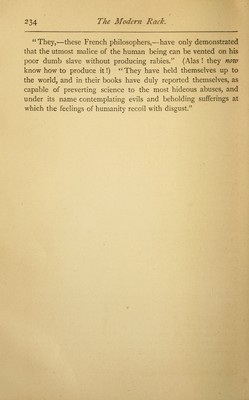
![changed; hair, straw, rags, tin shavings, stones, the most noisome and unnatural substances are then the delicacies for which the poor dog, changed by disease, longs and swallows in hopes to ease a burning stomach. He is now (in the more advanced stage) altogether changed. Still he does not desire to bite, he rather endeavours to avoid society. He takes long journeys of thirty or forty miles in extent, lengthened by all kinds of accidents, to vent his restless desire for motion. When on these journeys he does not walk. This would be too formal and measured a pace for an animal whose frame quivers with excitement He does not run. That would be too great an exertion for an animal whose whole body is the abode of a deadly sickness. He proceeds in a slouching manner—in a kind of trot—a movement neither a run nor a walk, and his aspect is dejected. His eyes do not glare and stare [as they did at first], but they are dull and retracted. His appearance is very characteristic, and, if once seen, can never afterwards be mistaken. In this state he will travel the most dusty roads, his tongue hanging dry from his open mouth, from which there drops no foam. His course is not straight. How could it be since it is doubtful whether at this period he sees at all ? His desire is to journey unnoticed. If no one notices him, he gladly passes by. He is very ill. He cannot stay to bite. If, nevertheless, anything oppose his progress, he will, as if by impulse, snap, as a man in a similar state might strike, and tell the person to ' get out of the way'. He may take his road across a field in which there are sheep. Could these creatures only make room for him and stand motionless, the dog would pass on and leave them uninjured. But they begin to run, and at the sound the dog pricks up. Rage takes possession of him. He flies at one, and then at another. He does not mangle, nor is his bite, simply considered, terrible. He snaps and rushes forward, till, fairly exhausted, he sinks down. If he escape and return home from these excursions he seeks the darkness and quiet of his former abode. His thirst increases, but with it comes the swelling of the throat. He will plunge his head into water, so ravenous is his desire, but not a drop of the](https://iiif.wellcomecollection.org/image/b21225734_0241.jp2/full/800%2C/0/default.jpg)