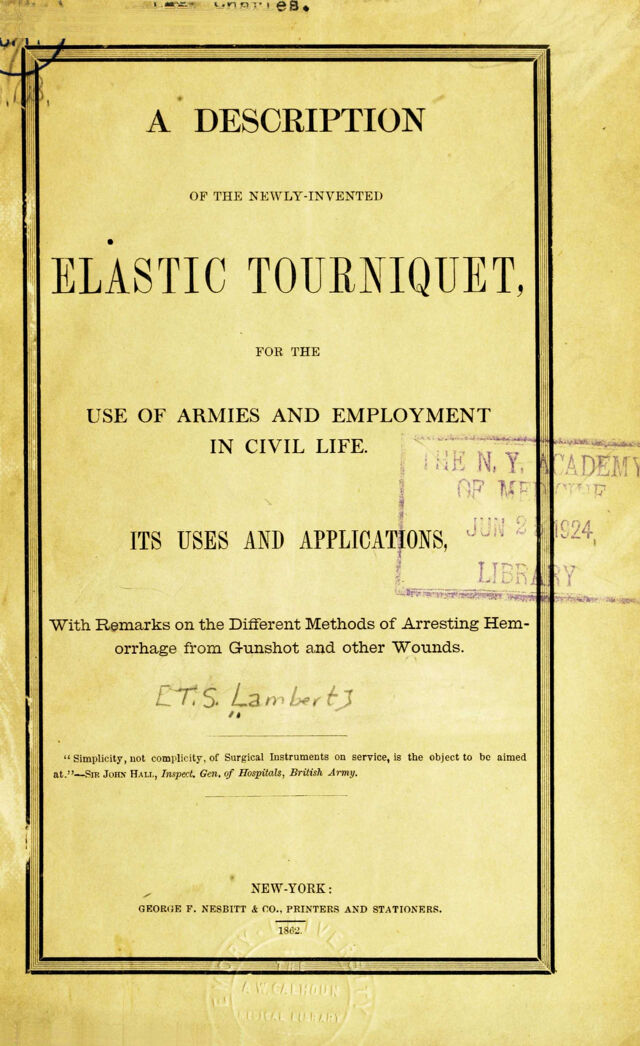
A description of the newly-invented elastic tourniquet, for the use of armies and employment in civil life : its uses and applications, with remarks on the different methods of arresting hemorrhage from gunshot and other wounds / by Thomas Scott Lambert.
- Lambert, T. S. (Thomas Scott), 1819-1897
- Date:
- 1862
Licence: Public Domain Mark
Credit: A description of the newly-invented elastic tourniquet, for the use of armies and employment in civil life : its uses and applications, with remarks on the different methods of arresting hemorrhage from gunshot and other wounds / by Thomas Scott Lambert. Source: Wellcome Collection.
Provider: This material has been provided by the Woodruff Health Sciences Center Library at Emory University, through the Medical Heritage Library. The original may be consulted at the Woodruff Health Sciences Center Library, Emory University.
6/38
![INTRODUCTORY REMARKS, The loss of life is so natural a consequence of uncontrolled bleeding from a large vessel, that surgeons have, in all ages, looked with anxiety to an efficient means of restraining hemorrhage ; and the reflection that three fourths of those who die in battle, perish from the loss of blood, is a circumstance noways cal- culated to diminish this anxiety. The sad experiences of war give importance to all methods of saving life on the battle-field, whether immediately endangered by hemorrhage, or indirectly by shock and exhaustion. Indeed, no subject has taxed the ingenuity of surgeons more than this ; namely, to discover the best and most certain modes of arresting the flow of blood, in time to save life, where large numbers lie bleeding on the field, and where the aid of army surgeons cannot, of course, be immediately rendered. All who have had experience in war, as well as all writers on military surgery, testify that this is, as yet, a most important desideratum. Hundreds, says Prof. S. D. Gross, die on the field of battle from this cause. They allow their life current to run out. as water flows from a hydrant, without an attempt to stop it by thrusting the finger in the wound, or compressing the main artery of the injured limb. They perish simply from their ignorance, because the regimental surgeon has failed to give the proper instruc- tion.—( Military Surgery. Phil., 1861.) These considerations, it is hoped, will cause the present effort in this direction to be received with all proper favor and indulgence. It has been stated by some writers that bleeding from gunshot wounds is rare ; but this is not the teaching of experience. A majority of writers on mili- tary surgery express the opinion that primary bleeding always takes place if a vessel of any size is injured : and Sanson testifies to the constant presence of hem- orrhage at the moment of injury. Macleod remarks, that it is unquestionable that a large number of the dead sink from hemorrhage.—( Notes on the Surgery of the War in the Crimea. Lond., 1858.) Let us look at some of the results of this war. In an effective force of 145,000 in the French army, 7,182 soldiers were killed, and 325 officers ; while 35,912 soldiers were wounded, and 1,625 officers—making a total of 37,587 wounded, treated in ambulances. Sixteen thousand were killed, or died of their wounds, or after operation ; and a vast majority of them died from exhaustion, caused by loss of blood. There were 5,000 French soldiers wounded at the taking of Sebastopol; and the proportion of very serious wounds, as compared with merely severe or slight, averaged one in 2]*,. One in five died on the place of combat from hemorrhage. Of the wounds, one in 4.3 was in the upper, and one in 3.5 in the lower, extremities.](https://iiif.wellcomecollection.org/image/b21037462_0006.jp2/full/800%2C/0/default.jpg)