An expository lexicon of the terms, ancient and modern, in medical and general science : including a complete medico-legal vocabulary and presenting the correct pronunciation ... / by R.G. Mayne.
- Mayne, R. G. (Robert Gray), 1808-1868.
- Date:
- 1860
Licence: Public Domain Mark
Credit: An expository lexicon of the terms, ancient and modern, in medical and general science : including a complete medico-legal vocabulary and presenting the correct pronunciation ... / by R.G. Mayne. Source: Wellcome Collection.
Provider: This material has been provided by The University of Leeds Library. The original may be consulted at The University of Leeds Library.
30/1538 page 2
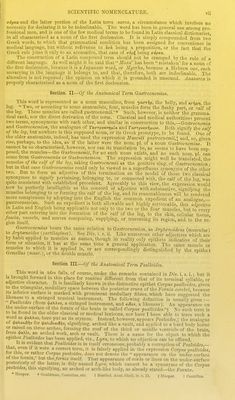
![ABBEEVIATUS-ABERIUTION. be found in their alijhabetical order. Abhre- vultio, Onis, f. Fr. anal, ahreviation, f. Abbreviatus, a, urn. {Ahbrevio, to make short, or to abridge.) Bot. Shortened, as when the cup is shorter than the tube of the flower: abbrev'iate; abbrev'iated. Fr syn. ahriiii, adj. Abcdaria Her'ba. Bot. A name given to the iDlaut Spilanthus acmella, because the Ethiopians gave it to then-children to chew, beheving it enabled them to pronounce then-letters better; also s^ult Ahecedaria. Abdelavi. (Arab.) Bot. Name for a kind of melon plant, growing in Egypt, the fruit of which IS of an insipid taste, but the seeds are reputed as refrigerant. Abdomen, inis, n. {Ahdo, to hide; because tlie abdominal viscera are hidden within its cavity.) Anat. Name for the largest cavity of the human body; the belly or abdomen. Covip. Anat. Applied to the same region in the lower animals. Also termed Venter See Imus Venter, Mirach, Nadtjs, Sumen. Fr. anal, abdomen, m.; syn. bas-ventre, m. Germ. syn. J5aMc7i, m.; Schvieerbauch, TO..; Unterbauch, m.; Unterleib, m. dictioiiiu-ies, omentum is added as a part of the derivation, to account for the last syUable of this word. The suggestion originated wifli Mar- tmius, It IS supposed, hut was long ago shewn to he erroneous, that syllable being merely a termination ot frequent use lu the Latin, as acamcra, from oaum foramen, from/oro, etc. • Abdom'inal. {Abdomen, the hoUj.) Anat. Of, or belonging to, or in some manner con' nected with the abdomen or beUy; ventral AbdOminalis, is, e. Fr. anal, abdomiiial, adj. Germ. syn. zum Schmeerhauche qe- norifi. Abdom'inal Aor'ta. Anat. Term for that portion of the aorta situated below the dia- phragm. Fr. anal, aorte abdominale. Germ syn. Unterleibes-Aorta. Abdom'inal Aponenro'sis. Anat. Term for the conjoined tendons of the oblique and transverse muscles on the anterior portion of the abdomen or beUy. Fr. anaJ. aponev- rose abdominale. Germ. syn. Unterleibes- Jb lechsenhaut. Abdom'inal Gan'glia. Anat. A name for the semilunar ganglia, from their situation. Fr anal, ganglions abdominaux. Geim svn Unterleibes-Knoten. Abdom'inal Ring. Anat. Term for the fan- cied rmg-hke openmg on each side of the abdomen, external and superior to the piibes, formed by the separation of the tendinous hbres of the lower portion of the external oblique muscle ; transmitting, in the male, the spermatic cord, and in the female, tlie roimd hgament. Annulus abdominis. Fr syn. anneau abdominal. Germ, syn Unter leibcs-Ring. Abdominales. See Abdominalis. Abdominalis, is e. {Abdomen, the belly.) IchtUyol. Of or belonging to tlie belly or abdomen; ventral; applied to an Order {Abdomi7iales. Nom. pi. f.) of fishes which Jave the ventral fins suspended to the under part of the abdomen, and behind the pec torals, without being attached to the bones of the shoulder: abdom'inal, which see. Abdominos'copy. {Abdimen, the belly; <r«o- Tco., to observe.) Med. Term for the operation or mode of ascertaining the exist- ence of abdominal disease by percussion mediate or immediate, by inspection, mea- surement, and manual examination. Abdo- minoscdpia, a, f. Fr. anal, abdominoscopie, f. Germ. syn. die Untersuclmng des Unterleibes. Abdu'cent. (^6, from ; dwo, to lead, or carry away.) Leading away from. Anat. Applied to muscles, by the action of which tlie members or limbs of the body to which they belong, are separated or drawn away from the mesial line; also applied to the sixth pair of nerves, or Nervi abducentes. AbdU- cens, tis, part. Fr. syn. abducteur, adj. Germ. syn. abzieliend, adj. Abducen'tes. {AbdUco, to lead away from.) Anat. A term applied to the sixth pair of nerves; the abducent nerves. Nom. pi. m. of Abducens, tis, part. See Abducent. Abduc'tion. {Abdtico, to lead away from.) Anat. Term for that movement by which one pai-t of the body, or a limb, is separated or led away from another, or from the mesial line. Surg. Formerly applied to a fracture in which the bone is so diiided transversely that its extremities recede from each other, Gr. syn. KavKnShv Karay/ia, ac- cording to Galen, Meth. vied, vi., so called from resemblance to a broken stem. Ap- plied also to a strain, and stated as one of the causes of ischiadic and psoadic pains by Coelius Am-elianus, Morb. chron. v. c. 1. Abductio, mis, f. See Abruption, Apagma. Fr. anal, abduction, f. Germ. syn. Abzie- hen,f.; Abziehung,{. Abduc'tor, oris, m. {Abdiico, to lead away from.) Anat. A leader from ; applied to a muscle which performs, or assists in per- foi-ming, abduction : an abduc'tor. Fr. syn. abducteur, m. Germ. syn. Abzieher, m. Abebaeos. ] ('A, neg. ; fidBaios, firm.) Abebaeus, a, urn. J M^d. Old term signifying weak or infirm, also inconstant; Gr. anal. aff40aia, used in the last sense by Hippo- crates, A2]h. ii. 27. Abecedaria Her'ba. Bot. See Abcdaria Herba. Abelicea, f. ('A, priv.; ^Se'Aoy, a dai-t; with- out thorns.) Bot. Old name for the Hama- toxylon Campechianum, or logwood. Abelmolucli. (Arab. Ab el moluk.) Bot. Name for a kind of Bicimts; applied to a tree growing neai- Mecca, having black ob- long seeds, said to be violently cathartic. Abelmos'chus, i, m. (Arab. Abel mosk, seed of musk.) Bot. Musk seed; abelmosh, or abelmusk; the specific name of the Hibiscus abelmoschus. Fr. anal, abelmosch, m.; syn. graine musquie. Germ. syn. Bisamkorn, d. Abepithym'ia, a, f. ('A, priv.; iwiOvfila, lust, or desire ; also, that pai-t of the soul which, according to Plato, resides in the abdomen.) Pathol. Name applied to a paralysis of the solar plexus, cutting off the communication between tlie nervous system and the abdo- minal \dscera, and destroying life. Aberra'tion. {Aberro, to wander away from.) A wandering or deviation from the usual course, or from tlie ordinary condition. Med., Pathol. Applied to a disordered](https://iiif.wellcomecollection.org/image/b21535656_0030.jp2/full/800%2C/0/default.jpg)

 No text description is available for this image
 No text description is available for this image
 No text description is available for this image