Iso amygdalin and the resolution of its hepta-acetyl derivative / by Frank Tutin.
- Tutin, Frank.
- Date:
- [1909?]
Licence: In copyright
Credit: Iso amygdalin and the resolution of its hepta-acetyl derivative / by Frank Tutin. Source: Wellcome Collection.
4/10 page 664
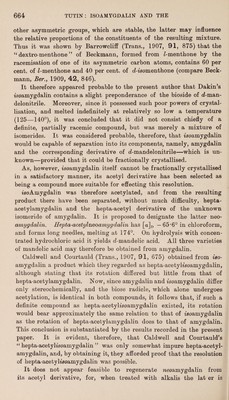
![other asymmetric groups, which are stable, the latter may influence the relative proportions of the constituents of the resulting mixture. Thus it was shown by Barrowcliff (Trans., 1907, 91, 875) that the “ dextro-menthone ” of Beckmann, formed from ^-menthone by the racemisation of one of its asymmetric carbon atoms, contains 60 per cent, of Z-menthone and 40 per cent, of d-isomenthone (compare Beck¬ mann, Ber., 1909, 42, 846). It therefore appeared probable to the present author that Dakin’s isoamygdalin contains a slight preponderance of the bioside of rf-man- delonitrile. Moreover, since it possessed such poor powers of crystal¬ lisation, and melted indefinitely at relatively so low a temperature (125—140°), it was concluded that it did not consist chiefly of a definite, partially racemic compound, but was merely a mixture of isomerides. It was considered probable, therefore, that isoamygdalin would be capable of separation into its components, namely, amygdalin and the corresponding derivative of d-mandelonitrile—which is un¬ known—provided that it could be fractionally crystallised. As, however, isoamygdalin itself cannot be fractionally crystallised in a satisfactory manner, its acetyl derivative has been selected as being a compound more suitable for effecting this resolution. isoAmygdalin was therefore acetylated, and from the resulting product there have been separated, without much difficulty, hepta- acetylamygdalin and the hepta-acetyl derivative of the unknown isomeride of amygdalin. It is proposed to designate the latter neo- amygdalin. Hepta-acetylneoamygdalin has [a]D - 65*6° in chloroform, and forms long needles, melting at 174°. On hydrolysis with concen¬ trated hydrochloric acid it yields d-mandelic acid. All three varieties of mandelic acid may therefore be obtained from amygdalin. Caldwell and Courtauld (Trans., 1907, 91, 675) obtained from iso- amygdalin a product which they regarded as hepta-acetyh'soamygdalin, although stating that its rotation differed but little from that of hepta-acetylamygdalin. Now, since amygdalin and isoamygdalin differ only stereochemically, and the biose radicle, which alone undergoes acetylation, is identical in both compounds, it follows that, if such a definite compound as hepta-acetyKsoamygdalin existed, its rotation would bear approximately the same relation to that of isoamygdalin as the rotation of hepta-acetylamygdalin does to that of amygdalin. This conclusion is substantiated by the results recorded in the present paper. It is evident, therefore, that Caldwell and Courtauld’s “ hepta-acetylisoamygdalin ” was only somewhat impure hepta-acetyl¬ amygdalin, and, by obtaining it, they afforded proof that the resolution of hepta-acetylisoamygdalin was possible. It does not appear feasible to regenerate weoamygdalin from its acetyl derivative, for, when treated with alkalis the lat er is](https://iiif.wellcomecollection.org/image/b30614405_0004.jp2/full/800%2C/0/default.jpg)