Report of the Royal Commission on the care and control of the feeble-minded, Volume VIII.
- Great Britain. Royal Commission on the Care and Control of the Feeble-minded.
- Date:
- 1908
Licence: In copyright
Credit: Report of the Royal Commission on the care and control of the feeble-minded, Volume VIII. Source: Wellcome Collection.
Provider: This material has been provided by Royal College of Physicians, London. The original may be consulted at Royal College of Physicians, London.
383/552 (page 351)
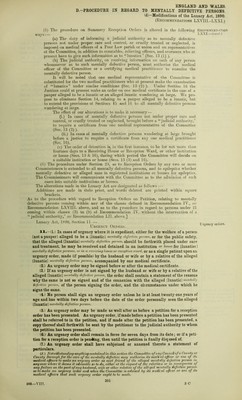
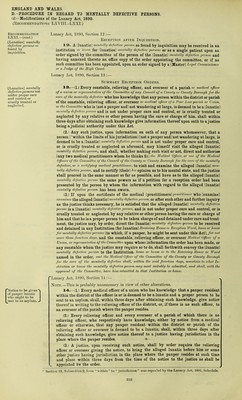
![D.—PROCEDURE IN REGARD TO MENTALLY DEFECTIVE PERSONS. (d)—Modifications of the Lunacy Act, 1890. (Recommendations LXVIII.-LXXI.) (.5) The procedure on Summary Reception Order.s is altered in the following ways:— (a) persons The duty of informing a judicial authority as to mentally defective not under proper care and control, or cruelly treated or neglected, is irapo.sed on medical officers of a Poor Law parish or union and on representatives of the Committee, in addition to constables, relieving officers, and overseers who at present have to give such information as to “lunatics” (Sec. 13 (1) ). (b) The judicial authority, on receiving information on oath of any person whomsoever as to such mentally defective person, must authorise the medical officer of the Committee or a certifying medical practitioner to examine the mentally defective person. It will be noted that one medical representative of the Committee is substituted for the two medical practitioners who at present make the examination of “lunatics” under similar conditions (Sec. 13 (2) ). Under Section 16 the Justices could at present make an order on one medical certificate in the case of a pauper alleged to be a lunatic or an alleged lunatic wandering at large. We pro- pose to eliminate Section 14, I’elating to a pauper alleged to be a lunatic, but to extend the provisions of Sections 15 and 16 to all mentally defective persons wandering at large. The effect of our alterations is to make it necessary— (i.) In cases of mentally defective persons not under proper care and control, or cruelly treated or neglected, brought before a “judicial authority,” to require a certificate from one medical representative of the Committee (Sec. 13(2)). (ii.) In cases of mentally defective persons wandering at large brought before a justice to require a certificate from any one medical practitioner (See. 16). (c) The order of detention is, in the first instance, to be for not more than fourteen days to a Receiving House or Reception AVard, or other institution or house (Secs. 13 & 16), during which period the Committee will decide on a suitable institution or house (Secs. 13 (3) and 16). (6) The procedure under Section 23, as to Reception Orders by any two or more Commissioners is extended to all mentally defective persons, and to epileptics whether mentally defective or alleged sane in registei’ed institutions or houses for epileptics. The Commissioners will communicate with the Committee as to the admission of such cases into suitable institutions or houses. The alterations made in the Lunacy Act are designated as follows :— Additions are made in italic print, and words deleted are printed within square brackets. As to the procedure with regard to Reception Orders on Petition, relating to mentally defective persons coming within any of the classes defined in Recommendation IV., see Recommendation LXVIII. above, and as to the procedure in regard to persons under 21 coming within classes (3) to (9) of Recommendation lA'. without the intervention of a “judicial authority,” see Recommendation LII. above.] Lunacy Act, 1890, Section 11 — Urgency Okdek«. Recommendation LXXI.—(ro«G) Urgency orders. XI.—(1.) In cases of urgency where it is expedient, either for the welfare of a person [not a pauper] alleged to be a [lunatic] mentally defective person, or for the public safety, that the alleged [lunatic] mentally defective person, should be forthwith placed under care and treatment, he may be received and detained in an institution or house for: [lunatics] mentally defective persons, or in a receiving house or reception ward, or as a single patient upon an urgency order, made (if possible) by the husband or wife or by a relative of the alleged [lunatic] mentally defective person, accompanied by one medical certificate. (2.) An urgency order may be signed before or after the medical certificate. (3.) If an urgency order is not signed by the husband or wife or by a relative of the alleged [lunatic] mentally defective person, the order shall contain a statement of the reasons why the same is not so signed and of the connexion with the alleged [lunatic] mentally iefective person, of the person signing the order, and the circumstances under which he signs the same. (4.) No person shall sign an urgency order unless he is at least twenty-one years of age and has within two days before the date of the order personally seen the alleged [lunatic] mentally defective person. (5.) An urgency order may be made as well after as before a petition for a reception order has been presented. An urgency order, if made before a petition has been presented shall be referred to in the petition, and if made after the petition has been presented, a copy thereof shall forthwith be sent by the petitioner to the judicial authority to whom the petition has been presented. (6.) An urgency order shall remain in force for seven days from its date; or if a peti- tion for a reception order is peniKng, then until the petition is finally disposed of. (7.) An urgency order shall have subjoined or annexed thereto a statement of particulars. (8.) Notwithstanding anything containedin this section the Committee of any Council of a County or County Borough for the care of the mentally defective may authorise its medical officer or one of its medical officers to make an urgency order as next friend of the alleged mentally dejective person in any ease where it deems it advisable so to do, either at the request of the relativis or in consequence of any failure on the part of any husband, wife or other relative of the alleged mentally defective person so to make an uraency order and when the Committee is advised by its medical officer or one of its medical officers that such urgency order ought to be made. 3 C 103.—A’lU.](https://iiif.wellcomecollection.org/image/b28038551_0383.jp2/full/800%2C/0/default.jpg)