Report of the Royal Commission on the care and control of the feeble-minded, Volume VIII.
- Great Britain. Royal Commission on the Care and Control of the Feeble-minded.
- Date:
- 1908
Licence: In copyright
Credit: Report of the Royal Commission on the care and control of the feeble-minded, Volume VIII. Source: Wellcome Collection.
Provider: This material has been provided by Royal College of Physicians, London. The original may be consulted at Royal College of Physicians, London.
46/552 page 14
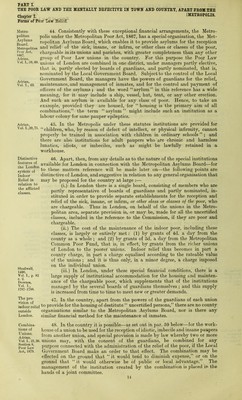
![THE POOR LAW AND THE MENTALLY DEFECTIVE IN TOWN AND COUNTRY, APART FROM THE Chapter I. [METROPOLIS. Forms of Poor Law Relief. Metro- politan Asylums Board. ]\Ietropolitan I’cor Act, 1867. Adrian, ^^ol. I„ 59, 60. Adrian, Vol. I., 63. Adrian, Vol. I.,39,71. 44. Consistently witli these exceptional financial arrangements, the Metro- polis under the Metropolitan Poor Act, 1867, has a special organisation, the Met- ropolitan Asylums Board, which enables it to provide asylums for the reception and relief of the sick, insane, or infirm, or other class or classes of the poor, chargeable in its unions and parishes, with greater completeness than any other group of Poor Law unions in the country. Por this purpose the Poor Law unions of London are combined in one district, under managers partly elective, that is, partly elected by boards of guardians, and partly nominated, that is, nominated by the Local Government Board. Subject to the control of the Local Government Board, the managers have the powers of guardians for the relief, maintenance, and management of inmates, and for the control and payment of officers of the asylums ; and the word “asylum” in this reference has a wide meaning, for it may include a ship, vessel, hut, tent, or any other erection. And such an asylum is available for any class of poor. Hence, to take an example, provided they are housed, for “ housing is the primary aim of all combinations,” the term “ asylum ” might include such an insGtution as a labour colony for sane pauper epileptics. 45. In the Metropolis under these statutes institutions are provided for “ children, who, by reason of defect of intellect, or physical infirmity, cannot properly be trained in association with children in ordinary schools ” ; and there are also institutions for adult paupers who are chronic and harmless lunatics, idiots, or imbeciles, such as might be lawfully retained in a workhouse. Distinctive features of the London system of Indoor Relief in relation to the afflicted classes. Shadwell, 1490, Vol. I., p. 82 c. 2. Downes, Vol. I., 1787-178.8. The pro- vision of indoor relief outside London. 46. Apart, then, from any details as to the nature of the special institutions available for London in connection with the Metropolitan Asylums Board—for to these matters reference will be made later on—the following points are distinctive of London, and suggestive in relation to any general organisation that may be proposed for the country at large :— (i.) In London there is a single board, consisting of members who are partly representative of boards of guardians and partly nominated, in- stituted in order to provide separate establishments for the reception and relief of the sick, insane, or infirm, or other class or classes of the poor, who are chargeable. Thus in London, on behalf of the unions in the Metro- politan area, separate provision is, or may be, made for all the uncertified classes, included in the reference to the Commission, if they are poor and chargeable. (ii.) The cost of the maintenance of the indoor poor, including these classes, is largely or entirely met: (1) by grants of 4d. a day from the county as a whole ; and (2) by grants of 5d. a day from the Metropolitan Common Poor Fund, that is, in effect, by grants from the richer unions of London to the poorer unions. Indoor relief thus becomes in part a county charge, in part a charge equalised according to the rateable value of the unions ; and it is thus only, in a minor degree, a charge imposed on the individual union. (iii.) In London, under these special financial conditions, there is a large supply of institutional accommodation for the housing and mainten- ance of the chargeable poor, which supplements that of the institutions managed by the several boards of guardians themselves ; and this supply is increased from time to time to meet new or greater demands. 47. In the country, apart from the powers of the guardians of each union to provide for the housing of destitute “ uncertified persons,” there are no county organisations similar to the Metropolitan Asylums Board, nor is there any similar financial method for the maintenance of inmates. Combina- 48. In the country it is possible—as set out in par. 59 below—for the work- tions of house of a union to be used for the reception of idiotic, imbecile and insane paupers Adr^n^ from another union, and special provision is made by law whereby two or more Vol. I., 21,36. unions may, with the consent of the guardians, be combined for any Foot Law purpose Connected with the administration of the relief of the poor, if the Local Act, 1879. Government Board make an order to that effect. The combination may be effected on the ground that “ it would tend to diminish expense,” or on the ground that “ it would otherwise be of public or local advantage.” The management of the institution created by the combination is placed in the hands of a joint committee.](https://iiif.wellcomecollection.org/image/b28038551_0046.jp2/full/800%2C/0/default.jpg)