The soluble ferments and fermentation / J. Reynolds Green.
- Joseph Reynolds Green
- Date:
- 1901
Licence: In copyright
Credit: The soluble ferments and fermentation / J. Reynolds Green. Source: Wellcome Collection.
28/540
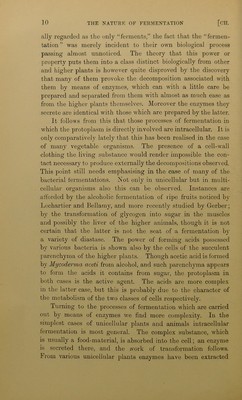
![An animal or vegetable cell is hence the centre of very vigorous activity; work is going on within it in the direction of incorporating material for the growth of the living substance, or of preparing material brought to it, so that it may be capable of such incorporation. Again some of its substance may be undergoing decomposition with a view to supplying the energy which -it needs for the maintenance of its vital processes. The chemical changes involved may be of three kinds. The decompositions may involve the incorporation of material into the actual substance of the protoplasm and the subsequent splitting off of various residues from the lattei-. Such appear to attend the formation of the various enzymes such as diastase; also the formation of fat, stgrch, and other compounds which can be seen in various cells. Other changes may take place without the establishment of such an intimate relationship with the protoplasm. They may be carried out by the protoplasm outside its own substance, the materials affected not being incorporated in it while the change is taking place. Such decompositions have been alluded to by various writers as caused by the fermentative action of protoplasm itself. A third class of reaction may take place in the cell with- out the actual intervention of the protoplasm at all. It is probable that processes of oxidation and reduction are taking place among the substances which occupy the meshes of the protoplasmic network, and that quiescent as the cell appears it is the seat of many chemical reactions of this kind. Thus the formation of sugar in the cells of leaves under the influence of chlorophyll, which probably involves the polymerisation of some form of aldehyde, need not necessarily involve the action of the living substance, as such polymerisation is very frequent among aldehyde bodies. Some of the decompositions of the latter class may be distin- guished from the others by the fact that though protoplasm is not immediately concerned in bringing them about, it pre]iares from its own substance an enzyme by which the transfonna- tion is effected. The secretion or formation of this new factor belongs to the first class of reactions mentioned, but the material once secreted is endowed with the power of](https://iiif.wellcomecollection.org/image/b28118534_0028.jp2/full/800%2C/0/default.jpg)

 No text description is available for this image
 No text description is available for this image
 No text description is available for this image