A lecture on the nature and government of the health, delivered at the Philosophical Institution, Cannon-Street, Birmingham, on December the 10th, 1839, to the members of the Lodges of United Brothers / by W. Watts.
- Watts, William.
- Date:
- 1840
Licence: Public Domain Mark
Credit: A lecture on the nature and government of the health, delivered at the Philosophical Institution, Cannon-Street, Birmingham, on December the 10th, 1839, to the members of the Lodges of United Brothers / by W. Watts. Source: Wellcome Collection.
Provider: This material has been provided by The University of Glasgow Library. The original may be consulted at The University of Glasgow Library.
32/40 (page 26)
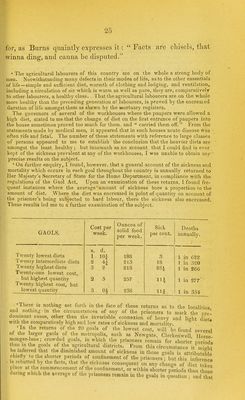
![20 the lieallli of tlio prisoners is proportionatfjly good in other goals, where the average ])eriods of confinemeut are long, hut where the diet is simple and the cost is low. It is to be observed also, that this objection does not apply to the inter- mediate diets compared with the highest diets ; there being, as will be seen in a subjoined table, no material differences in the periods of detention between the two classes. It is further to be observed, that in the goals where the cost of main- taining the prisoners has been reduced, the sickness of the prisoners has in no recent instance been increased, but has in general been diminished. According to this mode of obtaining the results, it appears that the attacks of sickness increase progressively with the increase of the dietaries. The mortality varies verv little ; but it is the highest where the diet is full. ' I might venture to assume from these facts, at least, that the sickness is increased as the quantity of food is increased ; and at all events, that the lowest actual dietaries have no deteriorating influence on the health of the prisoners,* But the evil consequences of ignorance of the cajmljilities and wants of the stomach, are severely felt by the sick man,— what is a more common error than that, if a man can but eat, he must do well, and thus against both stomach and sense, an organ that has been disabled by excess, is still tortured by excess,—and at a time when an absence from all food what- ever is the most desirable, the poor sufferer's palate is bribed into the enemy's service, and what between tid bits, and a drop of something comfortable, the poor stomach is well nigh destroyed for ever. The weaker the stomach the less it can digest, and it is only what is digested, not what is eaten, that adds to the strength of the body ; a small quantity well digested renews the strength both of the stomach and the whole body,—the very reverse happens if the stomach be op- pressed by a larger proportion. It becomes therefore the most solemn duty of the patient to adhere strictly to the advice of his medical attendant, whose studies and long experience are certainly to be preferred to the whims and fancies of igno- rant friends and neighbours.f •See page 48, 49, and 50, an Essay on the means of insurance against the casualities of Sickness, Decrepitude and Mortality, &c. Loudon, Charles Knight and Co. 22, L-udgate Hill, 1336. t Among other evils of this kind, there is one we cannot pass over. It is a com- mon practice, especially in this town, to eat large suppers. Tripe, the standing dish of the Birmingham Symj'osium, has done no little harm on this account. 1 never hear this ready at seven, proclaimed by the bellowing Corypha3Us of the Tripe House, but 1 fancy I see a liundred incubi and imps of indigestion.—Consider for a moment—the nature of the stomach, the decrease of its temperature and diminished power of digestion when sleeping, the recumbent position of the body, the indolent](https://iiif.wellcomecollection.org/image/b21473006_0032.jp2/full/800%2C/0/default.jpg)