Diseases and injuries of the teeth : including pathology and treatment / by Morton Smale and J.F. Colyer.
- Smale, Morton.
- Date:
- 1901
Licence: In copyright
Credit: Diseases and injuries of the teeth : including pathology and treatment / by Morton Smale and J.F. Colyer. Source: Wellcome Collection.
Provider: This material has been provided by The University of Glasgow Library. The original may be consulted at The University of Glasgow Library.
570/712 (page 550)
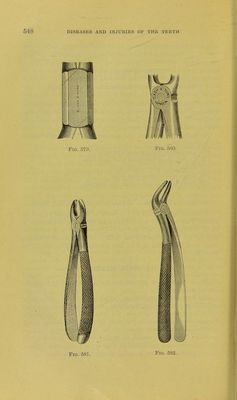
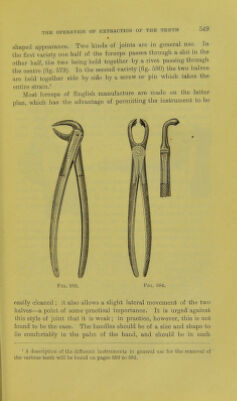
![relation to the blades that when the latter are applied in the direc- tion of the long axis of the tooth, the handles clear the lips. As a general rule, in forceps designed for the removal of the anterior teeth of the maxilla, the blades and handles are in the same line (fig. 581), while for the upper back teeth the handles form a curve of greater or less extent with the blades (fig. 582). In forceps for the mandibular teeth the blades are bent down from the handles to an angle of nearly ninety degrees. In one class named, the hawk's-bill, when the blades are apphed to the tooth the handles are at right angles to the Hne of the arch (fig. 583), while in other classes the handles are in line with the arch (fig. 584). Force]3S with aseptic or readily cleansable joints have been introduced. (2) METHOD OF HOLDING INSTRUMENTS. The manner of holding forceps is shown in figs. 585 to 587. The handles should rest comfortably in the palmar surface of the hand, and in such a manner that the end of one handle rests between the thenar and hypothenar eminences—a portion of the hand where force can be applied with the greatest advantage. The thumb placed between the handles acts as a regulator to control the pressure of the blades upon the tooth. As a precaution it is well to have the ball of the thumb well between the handles, so that the pressure is counteracted not only by the soft tissues, but also by the terminal bony phalanx of the thumb. If this pre- caution be nofc observed, any sudden crushing of the tooth may be accompanied by a severe and very painful contusion of the operator's thumb. The elevator, consists of two parts—the handle and the blade. The former, usually made of wood or ivory, is about four inches in length and of a shape suitable to allow a firm grip being ol^tained. The blade is of fine steel and about two inches long. Elevators are of two varieties,-straight and curved. In the first form the blade is thin, about one-fifth of an inch in breadth, one surface being made convex and the other flat. The point of the blade may be rounded as shown in fig. 588a, or, pear-shaped, as shown in fig. 588b. In the curved variety, the terminal half inch of the steel part of the instrument is bent at an angle with the shaft of the instrument](https://iiif.wellcomecollection.org/image/b21449715_0570.jp2/full/800%2C/0/default.jpg)