The composition of cinchona febrifuge / by J.A. Goodson and T.A. Henry.
- Goodson, John Augustus.
- Date:
- [1930]
Licence: Public Domain Mark
Credit: The composition of cinchona febrifuge / by J.A. Goodson and T.A. Henry. Source: Wellcome Collection.
8/16 page 242
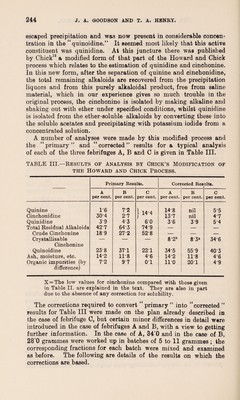
![sponds to 53*74 per cent, of quinine and 46*26 per cent, of cin- chonidine in the mixture or to 14*4 per cent, of quinine and 12*4 per cent, of cinchonidine expressed on the original febrifuge. Taking Rabe’s11 figures for the specific rotation, [a] » of quinine at — 158° and for cinchonidine at —111°, such a mixture should have a specific rotation [a]D —136°. The lower value found may be due to the presence of (a) hydroquinine [a] “ ~ 142°, (b) optically inactive material, or (c) possibly small amounts of cinchonine [a] d +229°, since it is hardly to be expected that an unpurified precipitate of this kind will be entirely free from the components of the precipitation liquors. The difference between the figures found from the methoxyl determination, viz., quinine 14*4 and cinchonidine 12*4, and those given, viz., 15*6 and 16*1 for these constituents in column 3, are due to the inclusion in the latter of the quantities of quinine and cinchonidine found in the “ quinine sulphate ” and the “ quinidine hydriodide ” precipitates, which were examined in the same way. In only one of the analyses of febrifuge B, viz., No. 7, were quinine and cinchonidine found. In this case they were precipi¬ tated together as tartrate and the relative quantities of the two alkaloids estimated on the recovered bases from the results of methoxyl determination. Quinidine. Precipitates which should have been “quinidine hydriodides” were obtained in all six analyses, but on examination these proved to be mainly dirt and saline material, and to contain but little alkaloid. Thus in analysis No. 1 (corrected results in column 3), small amounts of quinine and cinchonidine were precipitated at this stage and were added to the amounts of these alkaloids already found (see above.) From none of the hydriodide precipitates from either of the two febrifuges could any recognisable quantity of quinidine be obtained. Cinchonine. This alkaloid is estimated in this process by precipitating the residual alkaloids, after the removal of any quinine, cinchonidine and quinidine, with alkali and washing the precipitate with ether, or with alcohol of specific gravity 0*94, the assumption being that the amorphous alkaloids are soluble in either solvent and cinchonine insoluble. When the precipitates thus obtained from febrifuges A and B are treated in this way with ether the insoluble residues still contain considerable amounts of amorphous alkaloids, and the separation is no better with alcohol of sp. gr. 0*94. Various methods haye been tried in the hope of getting an approximate cinchonine determination, but without success. In analyses 1 and 2, the ether insoluble residue was crystallised from the minimum amount of alcohol and the sum of the crops obtained with the addition of the prescribed correction for the amounts (5*7 and 6*5 per cent, respectively) assumed to be left in the ether, is](https://iiif.wellcomecollection.org/image/b30628362_0008.jp2/full/800%2C/0/default.jpg)




 No text description is available for this image
 No text description is available for this image
 No text description is available for this image