The composition of cinchona febrifuge / by J.A. Goodson and T.A. Henry.
- Goodson, John Augustus.
- Date:
- [1930]
Licence: Public Domain Mark
Credit: The composition of cinchona febrifuge / by J.A. Goodson and T.A. Henry. Source: Wellcome Collection.
9/16 page 243
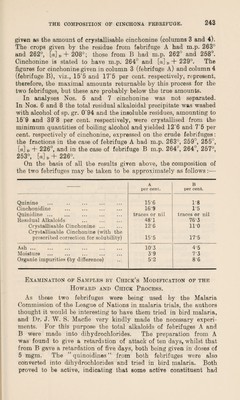
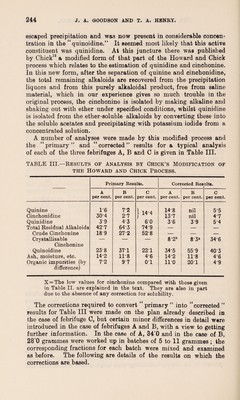
![given as the amount of crystallisable cinchonine (columns 3 and 4). The crops given by the residue from febrifuge A had m.p. 263° and 262°, [a] D + 208°; those from B had m.p. 262 and 258°. Cinchonine is stated to have m.p. 264° and [a] D + 229°. The figures for cinchonine given in column 3 (febrifuge A) and column 4 (febrifuge B), viz., 16‘5 and 17*5 per cent, respectively, represent, therefore, the maximal amounts returnable by this process for the two febrifuges, but these are probably below the true amounts. In analyses Nos. 5 and 7 cinchonine was not separated. In Nos. 6 and 8 the total residual alkaloidal precipitate was washed with alcohol of sp. gr. 0‘94 and the insoluble residues, amounting to 15*9 and 39*8 per cent, respectively, were crystallised from the minimum quantities of boiling alcohol and yielded 12*6 and 7'5 per¬ cent. respectively of cinchonine, expressed on the crude febrifuges: the fractions in the case of febrifuge A had m.p. 263°, 259°, 255°, [a] D + 226°, and in the case of febrifuge B m.p. 264°, 264°, 257°, 253°, [a]D+ 226°. On the basis of all the results given above, the composition of the two febrifuges may be takon to be approximately as follows:— A B per cent. per cent. Quinine 156 18 Cinchonidine 169 1-5 Quinidine ... traces or nil traces or nil Residual Alkaloids 48-1 76-3 Crystallisable Cinchonine ... Crystallisable Cinchonine (with the 126 110 prescribed correction for solubility) 15-5 1V5 •AsIt ••• ••• ••• ••• ••• 10-3 4'5 Moisture 39 7-3 Organic impurities (by difference) 5-2 86 Examination of Samples by Chick’s Modification of the Howard and Chick Process. As these two febrifuges were being used by the Malaria Commission of the League of Nations in malaria trials, the authors thought it would be interesting to have them tried in bird malaria, and Dr. J. W. S. Macfie very kindly made the necessary experi¬ ments. For this purpose the total alkaloids of febrifuges A and B were made into dihydrochlorides. The preparation from A was found to give a retardation of attack of ten days, w-hilst that from B gave a retardation of five days, both being given in doses of 5 mgm. The “ quinoidines ” from both febrifuges were also converted into dihydrochlorides and tried in bird malaria. Both proved to be active, indicating that some active constituent had](https://iiif.wellcomecollection.org/image/b30628362_0009.jp2/full/800%2C/0/default.jpg)




 No text description is available for this image
 No text description is available for this image
 No text description is available for this image