Introductory lecture delivered at the commencement of the winter session 1864-65, in the Medical School, Surgeons' Hall, Edinburgh / by Stevenson Macadam.
- Date:
- 1864
Licence: Public Domain Mark
Credit: Introductory lecture delivered at the commencement of the winter session 1864-65, in the Medical School, Surgeons' Hall, Edinburgh / by Stevenson Macadam. Source: Wellcome Collection.
Provider: This material has been provided by the Royal College of Physicians of Edinburgh. The original may be consulted at the Royal College of Physicians of Edinburgh.
3/16
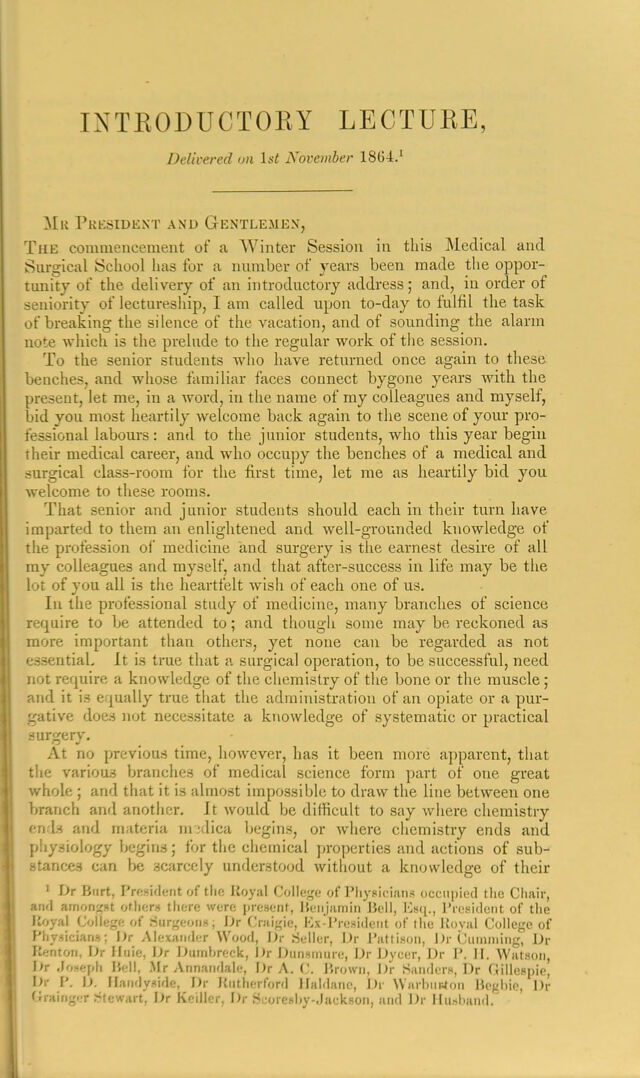
![Delivered on Ist November 1864.' Mr Pkksident and Gentlemen, The commencement of a AVinter Session in this Medical and Surgical School has for a number of years been made the oppor- tunity of the delivery of an introductory address; and, in order of seniority of lectureship, I am called upon to-day to fulfil the task of breaking the silence of the vacation, and of sounding the alarm note which is the prelude to the regular work of the session. To the senior students who have returned once again to these benches, and whose familiar faces connect bygone years with the present, let me, in a word, in the name of my colleagues and myself, bid you most heartily welcome back again to the scene of your pro- fessional labours: and to the junior students, who this year begin their medical career, and who occupy the benches of a medical and surgical class-room for the first time, let me as heartily bid you welcome to these rooms. That senior and junior students should each in their turn have imparted to them an enlightened and well-grounded knowledge of the profession of medicine and surgery is the earnest desire of all ray colleagues and myself, and that after-success in life may be the lot of you all is the heartfelt wish of each one of us. In the professional study of medicine, many branches of science require to be attended to; and though some may be reckoned as more important than others, yet none can be regarded as not essential. It is true that a surgical operation, to be successful, need not require a knowledge of the chemistry of the bone or the muscle ; and it is equally true that the administration of an opiate or a pur- gative does not necessitate a knowledge of systematic or practical surgery. At no previous time, however, has it been more apparent, that the various branches of medical science form part of one great whole ; and that it is almost impossible to draw the line between one branch and another. It would be difficult to say wiiere chemistry end.s and materia m';dica begins, or Avhere chemistry ends and physiology begins; for the chemical properties and actions of sub- stances can be .scarcely understood without a knowledge of their ' Dr Burt, Prftsiderit of tlic Royal Co]lci,'(; of I'liysicians occiipied the Chair, and arnon;,'st oth<;r» tliorc were jiresent, lieiijamin Bell, President of the lioyal Collef,'e of 8urgeoii»; iJr (Jniigie, Hx-l'resideiit of the Uovfil College of Physicians; Dr Alexander Wood, J)r .Seller, JJr l'attiH(jii, l)r (juinniing, Dr Kenton, Dr Huie, \)r Durrihreck, Dr I^untmure, Dr Dycer, Dr P. H. Watson, Dr Joseph Bell, .Mr Annandale, Dr A. V,. Jirowii, J)r Sanders, Dr Gillespie, Dr P. D. Ilandyside, Dr Jiiuherford llaldanc, Dr WarhiirJon Be^diie, Dr Grainger Stewart, Dr Keiller, Dr Seoreshy-Jackson, and Dr Ilii.sliand.'](https://iiif.wellcomecollection.org/image/b2191638x_0005.jp2/full/800%2C/0/default.jpg)