Syphilis / by V. Cornil ; translated, with notes and additions, by J. Henry C. Simes and J. William White.
- Victor André Cornil
- Date:
- 1882
Licence: Public Domain Mark
Credit: Syphilis / by V. Cornil ; translated, with notes and additions, by J. Henry C. Simes and J. William White. Source: Wellcome Collection.
Provider: This material has been provided by The University of Leeds Library. The original may be consulted at The University of Leeds Library.
421/480 page 419
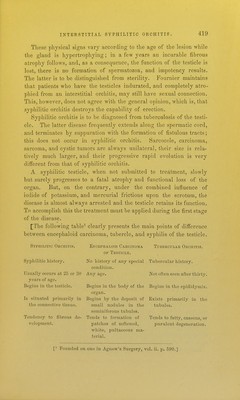
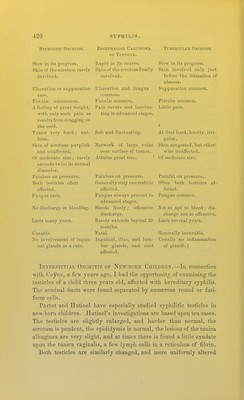
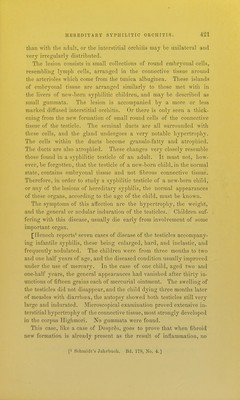
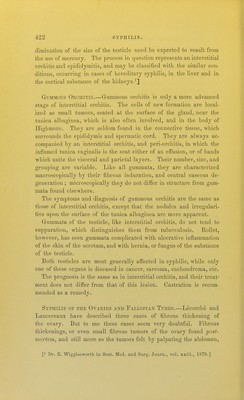
![These physical signs vaiy according to the age of the lesion while the gland is hypertrophying; in a few years an incurahle fibrous atrophy follows, and, as a consequence, the function of the testicle is lost, there is no formation of spei-matozoa, and impotency results. The latter is to be distinguished from sterility. Fournier maintains that patients who have the testicles indurated, and completely atro- phied from an interstitial orchitis, may still have sexual connection. This, however, does not agree with the general opinion, which is, that syphilitic orchitis destroys the capability of erection. Syphilitic orchitis is to be diagnosed from tuberculosis of the testi- cle. The latter disease frequently extends along the spermatic cord, and terminates by suppuration with the formation of fistulous tracts; this does not occur in syphilitic orchitis. Sarcocele, carcinoma, sarcoma, and cystic tumors are always unilateral, their size is rela- tively much larger, and their progressive rapid evolution is very different from that of syphilitic orchitis. A syphilitic testicle, when not submitted to treatment, slowly but surely progresses to a fatal atrophy and functional loss of the organ. But, on the contrary, under the combined influence of iodide of potassium, and mercurial frictions upon the scrotum, the disease is almost always arrested and the testicle retains its function. To accomplish this the treatment must be applied during the first stage of the disease. [The following table^ clearly presents the main points of difference between encephaloid carcinoma, tubercle, and syphilis of the testicle. Syphilitic ORcniTis. Syphilitic history. Usually occurs at 25 or 30 years of age. Begins in the testicle. Is situated primarily in the connective tissue. Tendency to fibrous de- velopment. Encephaloid Cargixojia OF Testicle. No history of any special condition. Any age. Begins in the body of the organ. Begins by the deposit of small nodules in the seminiferous tubules. Tends to formation of patclies of softened, white, pultaceous ma- t(!rial. Tubercular Orchitis. Tubercular history. Not often seen after thirt}'. Begins in the epididymis. Exists primarily in the tubules. Tends to fatty, caseous, or purulent degeneration. [' Founded on one in Agnew's Surgery, vol. 11. p. 590.]](https://iiif.wellcomecollection.org/image/b2151852x_0421.jp2/full/800%2C/0/default.jpg)