Syphilis / by V. Cornil ; translated, with notes and additions, by J. Henry C. Simes and J. William White.
- Victor André Cornil
- Date:
- 1882
Licence: Public Domain Mark
Credit: Syphilis / by V. Cornil ; translated, with notes and additions, by J. Henry C. Simes and J. William White. Source: Wellcome Collection.
Provider: This material has been provided by The University of Leeds Library. The original may be consulted at The University of Leeds Library.
422/480 page 420
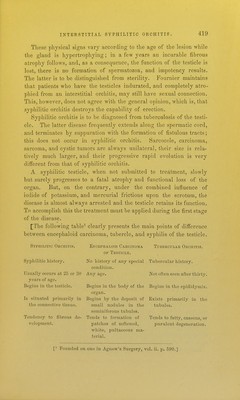
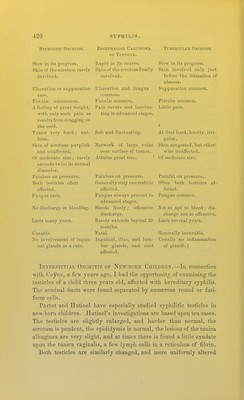
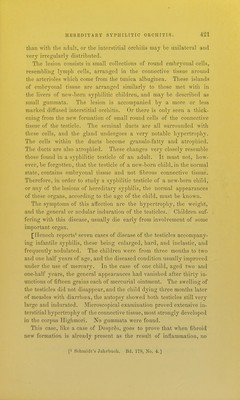
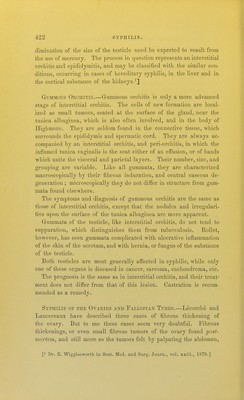
![Syphilitic Obchitis. Slow in its progress. Skin of the scrotum rarely involved. Ulceration or suppuration rare. Fistulse iincommon. A feeling of great weight, with only such pain as results from dragging on the cord. Tumor very hard; uni- form. Skin of scrotum purplish and \inaffected. Of moderate size ; rarely exceeds twice its normal diameter. Painless on pressure. Botli testicles often alfected. Fungus rare. No discharge or bleeding. Lasts many years. Curable. No involvement of ingui- nal glands as a rule. ExcKnrAi.oiD Caiicinoma OF Testicle. Rapid in its course. Skin of the scrotum finally involved. Ulceration and fungus common. Fistulfe common. Pain severe and lancina- ting in advanced stages. Soft and fluctuating. Network of large veins over surface of tumor. Attains great size. ' Painless on pressure. Generally only one testicle affected. Fungus always present in advanced stages. Bleeds freely; offensive discharge. Rarely extends beyond 20 months. Fatal. Inguinal, iliac, and lum- bar glands, and cord affected. TUBERCULAK OeOHITIS. Slow in its progress. Skin involved only just bcifore the formation of abscess. Suppuration common. Fistulae common. Little pain. At first hard, knotty, irre- gular. Skin congested, but other- wise unaffected. Of moderate size. Painful on pressure. Often both testicles af- fected. Fungus common. Not so apt to bleed; dis- charge not so offensive. Lasts several years. Generally incurable. Usuall}' no inflammation of glands.] Interstitial Orchitis of New-born Children.—In connection with Coyne, a few years ago, I had the opportunity of examining the testicles of a child three years old, affected with hereditary syphilis. The seminal ducts were found separated by numerous round or fusi- form cells. Parrot and Hutinel have especially studied syphilitic testicles in new-born children. Hutinel's investigations are based upon ten cases. The testicles are slightly enlarged, and harder than normal, the scrotum is pendent, the epididymis is normal, the lesions of the tunica albuginea are very slight, and at times there is found a little exudate upon the tunica vaginalis, a few lymph cells in a reticulum of fibrin. Both testicles are similarly changed, and more uniformly altered](https://iiif.wellcomecollection.org/image/b2151852x_0422.jp2/full/800%2C/0/default.jpg)