Syphilis / by V. Cornil ; translated, with notes and additions, by J. Henry C. Simes and J. William White.
- Victor André Cornil
- Date:
- 1882
Licence: Public Domain Mark
Credit: Syphilis / by V. Cornil ; translated, with notes and additions, by J. Henry C. Simes and J. William White. Source: Wellcome Collection.
Provider: This material has been provided by The University of Leeds Library. The original may be consulted at The University of Leeds Library.
424/480 page 422
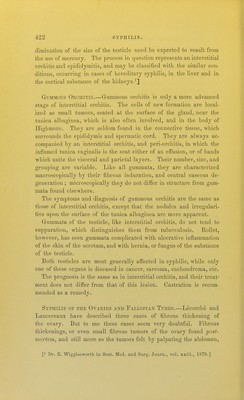
![diminution of the size of the testicle need be expected to result from the use of mercui-j. The process in question represents an interstitial orchitis and epididymitis, and.may be classified with the similar con- ditions, occurring in cases of hereditary syphilis, in the liver and in the cortical substance of the kidneys.'] GuMMOUS Orchitis.—Gummous orchitis is only a more advanced statue of interstitial orchitis. The cells of new formation are local- ized as small tumors, seated at the surface of the gland, near the tunica albuginea, which is also often involved, and in the body of Highmore. They are seldom found in the connective tissue, which surrounds the epididymis and spermatic cord. They are always ac- companied by an interstitial orchitis, and peri-orchitis, in which the inflamed tunica vaginalis is the seat either of an effusion, or of bands which unite the visceral and parietal layers. Their number, size, and grouping are variable. Like all gummata, they are characterized macroscopically by their fibrous induration, and centi'al caseous de- generation ; microscopically they do not differ in structure from gum- mata found elsewhere. The symptoms and diagnosis of gummous orchitis are the same as those of interstitial orchitis, except that the nodules and irregulari- ties upon the surface of the tunica albuginea are more apparent. Gummata of the testicle, like interstitial orchitis, do not tend to suppuration, which distinguishes them from tuberculosis. Rollet, however, has seen gummata complicated with ulcerative inflammation of the skin of the scrotum, and with hernia, or fungus of the substance of the testicle. Both testicles are most generally afiected in syphilis, while only one of these organs is diseased in cancer, sarcoma, enchondroma, etc. The prognosis is the same as in interstitial orchitis, and their treat- ment does not diff'er from that of this lesion. Castration is recom- mended as a remedy. Syphilis of the Ovaries and Fallopian Tubes.—Lecorche and Lancereaux have described three cases of fibrous thickening of the ovary. But to me these cases seem very doubtful. Fibrous thickenings, or even small fibrous tumors of the ovary found post- mortem, and still more so the tumors felt by palpating the abdomen, [' Dr. E. Wiggleswortli iu Bost. Med. and Surg. .Jouru., vol. xxiii., 1S79.]](https://iiif.wellcomecollection.org/image/b2151852x_0424.jp2/full/800%2C/0/default.jpg)