The microscope: and its revelations / by William B. Carpenter; with an appendix containing the applications of the microscope to clinical medicine, etc. By Francis Gurney Smith.
- William Benjamin Carpenter
- Date:
- 1856
Licence: Public Domain Mark
Credit: The microscope: and its revelations / by William B. Carpenter; with an appendix containing the applications of the microscope to clinical medicine, etc. By Francis Gurney Smith. Source: Wellcome Collection.
90/768 page 92
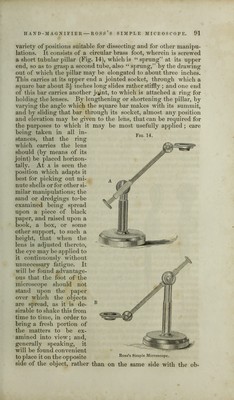
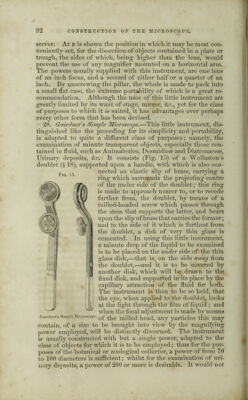
![server. At b is shown the position in which it may he most con- veniently set, for the dissection of objects contained in a plate or trough, the sides of which, being higher than the lens, would prevent the use of any magnifier mounted on a horizontal arm. The powers usually supplied with this instrument, are one lens of an inch focus, and a second of either half or a quarter of an inch. By unscrewing the pillar, the whole is made to pack into a small flat case, the extreme portability of which is a great re- commendation. Although the uses of this little instrument are greatly limited by its want of stage, mirror, &c., yet for the class of purposes to which it is suited, it has advantages over perhaps every other form that has been devised. 28. Grairdners Simple Microscope.—This little instrument, dis- tinguished like the preceding for its simplicity and portability, is adapted to quite a different class of purposes; namely, the examination of minute transparent objects, especially those con- tained in fluid, such as Animalcules, Desmidiese and Diatomacese, Urinary deposits, &c. It consists (Fig. 15) of a Wollaston’s doublet (§ 18), supported upon a handle, with which is also con- nected an elastic slip of brass, carrying a ring which surrounds the projecting centre of the under side of the doublet; this ring is made to approach nearer to, or to recede further from, the doublet, by means of a milled-headed screw which passes through the stem that supports the latter, and bears upon the slip of brass that carries the former; and to the side of it which is furthest from the doublet, a disk of very thin glass is cemented. In using this little instrument, a minute drop of the liquid to be examined is to be placed on the under side of the thin glass disk,—that is, on the side away from the doublet,—and it is to be covered by another disk, which will be drawn to the fixed disk, and supported in its place by the capillary attraction of the fluid for both. The instrument is then to be so held, that the eye, when applied to the doublet, looks at the light through the film of liquid ; and when the focal adjustment is made by means Gairdner’s simple Microscope. mp]e(j hea^ any particles this may contain, of a size to be brought into view by the magnifying power employed, will be distinctly discerned. The instrument is usually constructed with but a single power, adapted to the class of objects for which it is to be employed; thus for the pur- poses of the botanical or zoological collector, a power of from TO to 100 diameters is sufficient; whilst for the examination of uri- nary deposits, a power of 200 or more is desirable. It would not](https://iiif.wellcomecollection.org/image/b28136974_0090.jp2/full/800%2C/0/default.jpg)
 No text description is available for this image
 No text description is available for this image
 No text description is available for this image