Licence: Public Domain Mark
Credit: A history of the British zoophytes / by George Johnston. Source: Wellcome Collection.
Provider: This material has been provided by the Royal College of Physicians of Edinburgh. The original may be consulted at the Royal College of Physicians of Edinburgh.
104/460 page 84
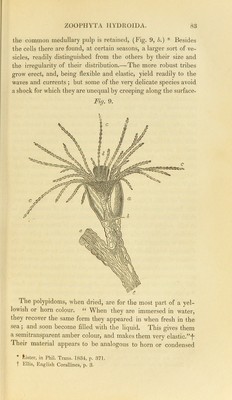
![albumen, which is moulded into a homogeneous investing sheath, for the protection of the semifluid pulpous body. It seems to be in fact a sort of hardened epidermis, at first in contact and partial ad- hesion with the living interior pulp, from which it is subsequent- ly detached, in the natural progress of its consolidation, by a process of shrivelling in the soft matter, and by the motions and efforts of the polypes themselves.* Link says that the experi- ments he has made on the Plumularia falcata and the Sertularia cupressina have led him to adopt the opinion of Cavolini and Schweigger, that this sheath is vascular and organized, for, un- der a very powerful magnifier, he has seen coloured vessels ra- mified in the stem and branches of these polypidoms. He is also certain that their stems are often increased with age by con- centric layers, and that the calcareous matter is deposited in true cells.*f- These observations are intended to support the theory of the independent growth of the polypidom from innate living motions or a vegetative principle, but notwithstanding Link’s high authority, I would caution the student against a too hasty reception of the facts. They are at variance with the experi- ments of Ellis, Grant and Blainville; nor does Dr Fleming nor Mr Lister appear ever to have noticed traces of vascularity in these objects during their microscopical inquiries; and I have in vain sought for the existence of vessels in some transparent species, as Sertularia rosacea and Campanularia gelatinosa, where it seemed likely they would most easily be detected. Dr Fleming, from observations of a different kind, as e. g. the con- version of cells into vesicles and of these into branches, or even of the polypes themselves into branches, in the Plumularia bullata and Campanularia gelatinosa, has come to the conclusion that the polypidom is, in its mode of growth, analogous to hone^ “ a circumstance on which its apparent vegetating power de- pends”]; ; but since L suspect the accuracy of the alleged ob- servations, and cannot, on reflection, perceive where the analo- gy between these horny sheaths and bone lies, I am necessitated * See Lister’s Observations in Phil. Trans. 1834, p. 374; and Lam. Anim. s. Vert. ii. 119. 2de edit. Milne-Edwards also tells us that there is a canal down the centre of the soft pulp in which the circulation is carried on. Is not this a transcendental piece of anatomy ? f Ann. des Sciences Nat. Part. Dot. Vol. ii. p. 321. :}: Memoirs of the Wernerian Soc. Vol. v. p, 303—6.](https://iiif.wellcomecollection.org/image/b21910479_0104.jp2/full/800%2C/0/default.jpg)
 No text description is available for this image
 No text description is available for this image
 No text description is available for this image