The mystical hymns of Orpheus / Translated from the Greek, and demonstrated to be the invocations which were used in the Eleusinian mysteries, by Thomas Taylor.
- Date:
- 1824
Licence: Public Domain Mark
Credit: The mystical hymns of Orpheus / Translated from the Greek, and demonstrated to be the invocations which were used in the Eleusinian mysteries, by Thomas Taylor. Source: Wellcome Collection.
258/278 (page 198)
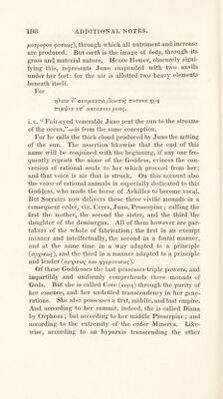
![yorpotyov (pvatiog), through which all nutriment and increase are produced. But earth is the image of body, through its gross and material nature. Hence Homer, obscurely signi¬ fying this, represents Juno suspended with two anvils under her feet: for the air is allotted two heavy elements beneath itself. For i]\iov o’ aKayavra /3oa>7ric; ttotviu ypy Trtyiptv err’ (okecivoio poag. i. e. u Fair-eyed venerable Juno sent the sun to the streams of the ocean,”—is from the same conception. For he calls the thick cloud produced by Juno the setting of the sun. The assertion likewise that the end of this name will be conjoined with the beginning, if any one fre¬ quently repeats the name of the Goddess, evinces the con¬ version of rational souls to her which proceed from her; and that voice is air that is struck. On this account also the voice of rational animals is especially dedicated to this Goddess, who made the horse of Achilles to become vocal. But Socrates now delivers these three vivific monads in a consequent order, viz. Ceres, Juno, Proserpine ; calling the first the mother, the second the sister, and the third the daughter of the demiurgus. All of them however are par¬ takers of the whole of fabrication; the first in an exempt manner and intellectually, the second in a fontal manner, and at the same time in a way adapted to a principle (apxt-Kojg), and the third in a manner adapted to a principle and leader (apxacojg kcu yyeyoviKoyg). Of these Goddesses the last possesses triple powers, and impartibly and uniformly comprehends three monads of Gods. But she is called Core (jeep??) through the purity of her essence, and her undefiled transcendency in her gene¬ rations. She also possesses a first, middle, and last empire. And according to her summit, indeed, she is called Diana by Orpheus; but according to her middle Proserpine; and according to the extremity of the order Minerva. Like¬ wise, according to an hyparxis transcending the other](https://iiif.wellcomecollection.org/image/b29340548_0258.jp2/full/800%2C/0/default.jpg)