The mystical hymns of Orpheus / Translated from the Greek, and demonstrated to be the invocations which were used in the Eleusinian mysteries, by Thomas Taylor.
- Date:
- 1824
Licence: Public Domain Mark
Credit: The mystical hymns of Orpheus / Translated from the Greek, and demonstrated to be the invocations which were used in the Eleusinian mysteries, by Thomas Taylor. Source: Wellcome Collection.
265/278 (page 205)
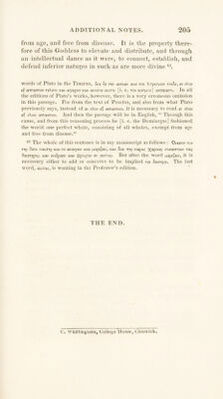
![from age, and free from disease. It is the property there¬ fore of tills Goddess to elevate and distribute, and through an intellectual dance as it were, to connect, establish, and defend inferior natures in such as are more divine 43. words of Plato in the Timseus, Jia -n)v amav xai rov Xcyig-^ov rcySe, ev oXov £' oltzovtw teXsov xutt uyr,qujv xai avotrov av/rov [i. e. tov xotr/j.oy] £y.Tryoiro. In all the editions of Plato’s works, however, there is a very erroneous omission in this passage. For from the text of Proelus, and also from what Plato previously says, instead of ry oXov £? airocvnov, it is necessary to read ev oXov f? oKuiv carctvTwv. And then the passage will be in English, “ Through this cause, and from this reasoning process he [i. e. the Demiurgus] fashioned the world one perfect whole, consisting of all wholes, exempt from age and free from disease.” 43 The whole of this sentence is in my manuscript as follows : ouv t9eou Taurrjf xat to avayfiv xoa fxepfav, xai Jias ttk voffaf vuvcctteiv tok SeioTEfoif, uca eviSgvew xat spgoufstv ev auro»j. But after the wrord fjicp^eiv, it is necessary either to add or conceive to be implied t« Sevt^os. The last word, avroip, is wanting in the Professor’s edition. THE END. C. Whittingham, College House, Chiswick.](https://iiif.wellcomecollection.org/image/b29340548_0265.jp2/full/800%2C/0/default.jpg)