Lamb dysentery : an account of some experimental field work in 1925 and 1926 / by T. Dalling.
- Dalling, Thomas.
- Date:
- [1926?]
Licence: In copyright
Credit: Lamb dysentery : an account of some experimental field work in 1925 and 1926 / by T. Dalling. Source: Wellcome Collection.
7/24 page 149
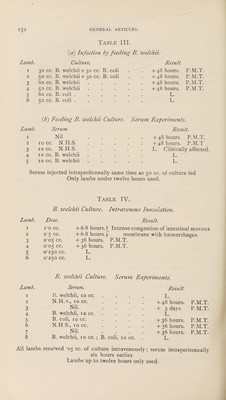
![lambing to fields where for many years cattle only had been grazed. The lambs sucked their mothers throughout the experiment. Infection with Natural Material. [a] Feeding.—In 1925 we were unable to infect lambs by feeding intestinal contents, ground-up ulcers, etc., from natural cases ; eg., one two days old lamb was fed a quantity of such material, obtained from three naturally infected lambs, suspended in saline solution, but showed no symptoms. In 1926 the technique was altered somewhat. After failure to infect two young lambs, material from hyperacute cases only was used ; this was mixed with glucose broth and fed by stomach tube to two healthy lambs under twelve hours old ; infection took place and death occurred within forty-eight hours. In a sub¬ sequent experiment five lambs less than twelve hours old were given by the mouth 30 cc. of intestinal contents of naturally infected lambs. Two of these received 10 cc. of normal horse serum intraperitoneally ; one, and the control lamb, died with typical symptoms in forty-eight hours. The other passed blood-stained mucus for several days but eventually recovered. The other two lambs, which received 10 cc. B. welchii antiserum, showed no symptoms. The serum which was obtained from horses by the injection of strains of B. welchii isolated from naturally occurring cases apparently gave complete protection. (J?) Intravenous Inoculation.—In 1925 (2), and again in 1926, we reproduced in lambs lesions resembling macroscopically those found in naturally occurring cases by the intravenous injection of intestinal contents of acutely affected lambs. The results of these experiments appear in Table I. The only lamb which received B. welchii anti¬ serum, six hours prior to the intravenous inoculation of intestinal contents, lived. (c) Umbilical Infection.—In 1925 (2) an ulcer from the intestine of an affected lamb was inserted into the open umbilicus of a young healthy lamb. On the fourth day the lamb was killed and several ulcers were found in the intestinal mucous membrane. We have attempted this method of reproduction on many occasions during the past lambing season, and, in addition, on twelve occasions we have inserted into the open umbilicus actual intestinal contents from lambs acutely affected ; but, although four of the experimental lambs have died after such treatment, we have never been able to satisfy ourselves that we have reproduced a condition simulating the natural disease. Infection by the Use of Cultures of Organisms. The cultures used have been strains of B. welchii and B. coli isolated from naturally affected lambs. (a) Feeding.—The feeding of cultures of B. welchii and B. coli together, as was done in 1923 (1), has been repeated on six occasions](https://iiif.wellcomecollection.org/image/b30625750_0007.jp2/full/800%2C/0/default.jpg)