Annual report of the managers of the State Lunatic Asylum : made to the Legislature January 18, 1844 / New York State Lunatic Asylum at Utica.
- New York (State). State Lunatic Asylum
- Date:
- 1844
Licence: Public Domain Mark
Credit: Annual report of the managers of the State Lunatic Asylum : made to the Legislature January 18, 1844 / New York State Lunatic Asylum at Utica. Source: Wellcome Collection.
35/70 page 33
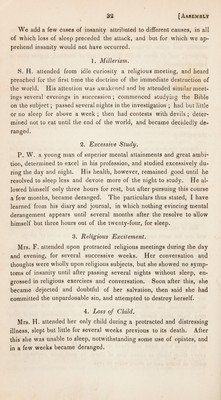
![5, Loss of Property, Mr. J. a high spirited, proud, but worthy merchant, lost his property by some ill-judged investments of capital. During his embarrassment, and soon after it, he often spoke of his inability to sleep, and remarked to a friend that he “ had not slept one hour in any one night for more than a month soon after this he became insane. In these instances, and many similar might be adduced, excitement and anxiety of mind produced loss of sleep, and insanity was the con- sequence. Had the mental anxiety not had the effect to prevent sleep, insanity would not probably have occurred. Some have doubted whether insanity is ever produced by attendance on religious meetings, and hearing certain religious doctrines inculcated, as for instance that of the immediate destruction of the world ; and have appeared to think, if such is the fact, it might be adduced as evidence of the incorrectness of such doctrines. Not so : all that it proves is, that they have taken strong hold of the feelings and intensely occupied the mind. It would be strange indeed if they should not. Truth is as powerful to excite the feelings as error; and of all truths those connected with religion most stronglv interest the human mind, and while to thousands they bring consolation and hope, and calm the dis¬ quieted mind, and thus no doubt save many from derangement, to a few of very excitable temperament, or to those already predisposed to insanity they cause a loss of sleep, and occasionally insanity. The error is not so much in the doctrine preached, as in the too fre- quent or too long continued and untimely attendance of excitable and nervous persons upon such meetings. They should be advised not to at¬ tend frequently, especially evenings. All agree that it would be often injurious to preach to the sick in a manner that would be proper and useful to the healthy, but in every neighborhood are some nervous and easily excited individuals, who are as liable to be injured by exciting preaching as those actually sick. The number of cases attributed to religious excitement is large. Many, if not the most of them, occurred during, or soon after long at¬ tendance on protracted religious meetings, and full one half were indi¬ viduals of unquestionable piety previous to their attendance on such meetings. But their feelings having become strongly engaged, and their sympathies awakened for those who were anxious, they became [Assembly, No. 21.] 5](https://iiif.wellcomecollection.org/image/b30317472_0035.jp2/full/800%2C/0/default.jpg)