Studies in intracranial physiology & surgery : the third circulation, the hypophysis, the gliomas / by Harvey Cushing.
- Harvey Williams Cushing
- Date:
- 1926
Licence: In copyright
Credit: Studies in intracranial physiology & surgery : the third circulation, the hypophysis, the gliomas / by Harvey Cushing. Source: Wellcome Collection.
141/168 page 125
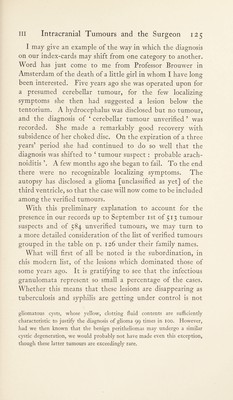
![I may give an example of the way in which the diagnosis on our index-cards may shift from one category to another. Word has just come to me from Professor Brouwer in Amsterdam of the death of a little girl in whom I have long been interested. Five years ago she was operated upon for a presumed cerebellar tumour, for the few localizing symptoms she then had suggested a lesion below the tentorium. A hydrocephalus was disclosed but no tumour, and the diagnosis of 4 cerebellar tumour unverified ’ was recorded. She made a remarkably good recovery with subsidence of her choked disc. On the expiration of a three years’ period she had continued to do so well that the diagnosis was shifted to ‘ tumour suspect : probable arach¬ noiditis ’. A few months ago she began to fail. To the end there were no recognizable localizing symptoms. The autopsy has disclosed a glioma [unclassified as yet] of the third ventricle, so that the case will now come to be included among the verified tumours. With this preliminary explanation to account for the presence in our records up to September 1st of 513 tumour suspects and of 584 unverified tumours, we may turn to a more detailed consideration of the list of verified tumours grouped in the table on p. 126 under their family names. What will first of all be noted is the subordination, in chis modern list, of the lesions which dominated those of some years ago. It is gratifying to see that the infectious granulomata represent so small a percentage of the cases. Whether this means that these lesions are disappearing as tuberculosis and syphilis are getting under control is not gliomatous cysts, whose yellow, clotting fluid contents are sufficiently characteristic to justify the diagnosis of glioma 99 times in 100. However, had we then known that the benign peritheliomas may undergo a similar cystic degeneration, we would probably not have made even this exception, though these latter tumours are exceedingly rare.](https://iiif.wellcomecollection.org/image/b29929209_0141.jp2/full/800%2C/0/default.jpg)




 No text description is available for this image
 No text description is available for this image
 No text description is available for this image