Wellcome Collection homepage
  • Visit us
  • What’s on
  • Stories
  • Collections
  • Get involved
  • About us
Sign in to your library account
Search for anything
Library account
Take me back to the item page

Punjab.

Date:
1908
Catalogue details

Licence: In copyright

Credit: Punjab. Source: Wellcome Collection.

  • Cover
  • Title Page
  • Table of Contents
  • Index
  • Cover
    35/486 (page 3)
    Previous page
    Next page
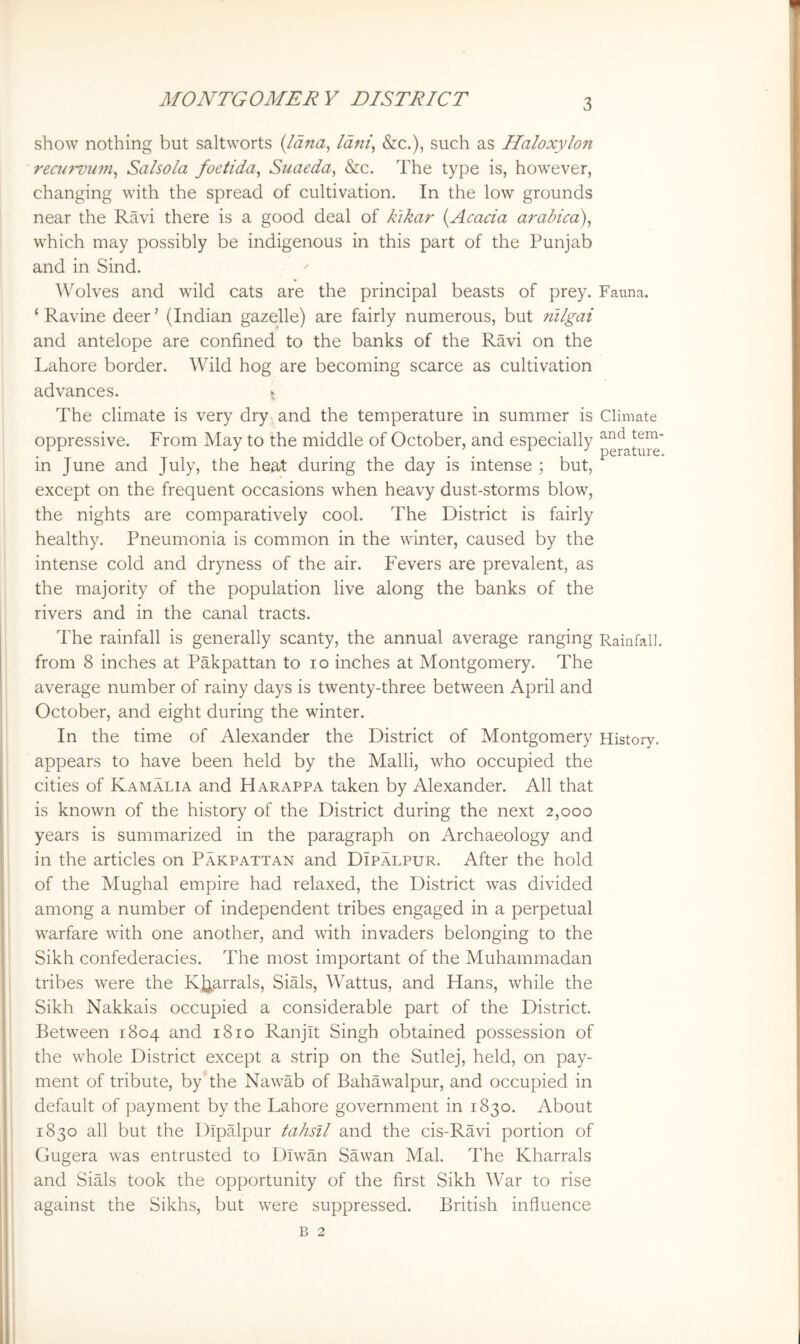
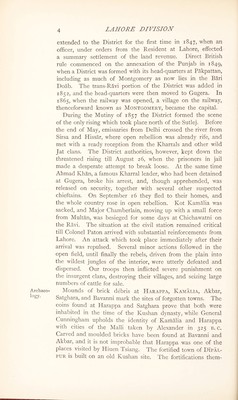
    show nothing but saltworts {/ana, Idni, &c.), such as Haloxylon recnrvum, Sa/so/a foetida, Suaeda, &c. The type is, however, changing with the spread of cultivation. In the low grounds near the Ravi there is a good deal of /ii/iar {Acacia arabica), which may possibly be indigenous in this part of the Punjab and in Sind. A\'olves and wild cats are the principal beasts of prey. Fauna. ‘ Ravine deer ’ (Indian gazelle) are fairly numerous, but nilgai and antelope are confined to the banks of the Ravi on the Lahore border. Wild hog are becoming scarce as cultivation advances. t The climate is very dry and the temperature in summer is Climate oppressive. From May to the middle of October, and especially in June and July, the heat during the day is intense ; but, except on the frequent occasions when heavy dust-storms blow, the nights are comparatively cool. The District is fairly healthy. Pneumonia is common in the winter, caused by the intense cold and dryness of the air. Fevers are prevalent, as the majority of the population live along the banks of the rivers and in the canal tracts. The rainfall is generally scanty, the annual average ranging Rainfall, from 8 inches at Pakpattan to lo inches at Montgomery. The average number of rainy days is twenty-three between April and October, and eight during the winter. In the time of Alexander the District of Montgomery History, appears to have been held by the Malli, who occupied the cities of Kamalia and Harappa taken by Alexander. All that is known of the history of the District during the next 2,000 years is summarized in the paragraph on Archaeology and in the articles on Pakpattan and Dipalpur. After the hold of the Mughal empire had relaxed, the District was divided among a number of independent tribes engaged in a perpetual warfare with one another, and with invaders belonging to the Sikh confederacies. The most important of the Muhammadan tribes were the KJ^arrals, Sials, Wattus, and Hans, while the Sikh Nakkais occupied a considerable part of the District. Between 1804 and 1810 Ranjit Singh obtained possession of the whole District except a strip on the Sutlej, held, on pay- ment of tribute, by the Nawab of Bahawalpur, and occupied in default of payment by the Lahore government in 1830. About 1830 all but the Dipalpur tahsil and the cis-Ravi portion of Gugera was entrusted to Diwan Sawan Mai. The Kharrals and Sials took the opportunity of the first Sikh War to rise against the Sikhs, but were suppressed. British influence B 2
    page 27
    31
    page 28
    32
    page 1
    33
    page 2
    34
    page 3
    35
    page 4
    36
    Previous page
    Next page

    Wellcome Collection

    183 Euston Road
    London NW1 2BE

    +44 (0)20 7611 2222
    info@wellcomecollection.org

    • Getting here

    Today’s opening times

    • Galleries
      10:00 – 18:00
    • Library
      10:00 – 18:00
    • Café
      10:00 – 18:00
    • Shop
      10:00 – 18:00

    Opening times

    Our building has:

    • Step free access
    • Hearing loops

    Accessibility

    • Visit us
    • What’s on
    • Stories
    • Collections
    • Get involved
    • About us
    • Contact us
    • Jobs
    • Media office
    • Developers
    • Privacy and terms
    • Cookie policy
    • Manage cookies
    • Modern slavery statement
    TikTok
    Facebook
    Instagram
    YouTube

    Except where otherwise noted, content on this site is licensed under a Creative Commons Attribution 4.0 International Licence