Wellcome Collection homepage
  • Visit us
  • What’s on
  • Stories
  • Collections
  • Get involved
  • About us
Sign in to your library account
Search for anything
Library account
Take me back to the item page

Punjab.

Date:
1908
Catalogue details

Licence: In copyright

Credit: Punjab. Source: Wellcome Collection.

  • Cover
  • Title Page
  • Table of Contents
  • Index
  • Cover
    36/486 (page 4)
    Previous page
    Next page
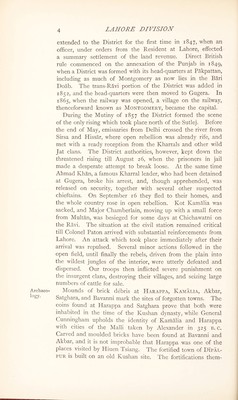
    Archaeo- logy. extended to the District for the first time in 1847, when an officer, under orders from the Resident at Lahore, effected a summary settlement of the land revenue. Direct British rule commenced on the annexation of the Punjab in 1849, when a District was formed with its head-quarters at Pakpattan, including as much of Montgomery as now lies in the Bari Doab. The trans-Ravi portion of the District was added in 1852, and the head-quarters were then moved to Gugera. In 1865, when the railway was opened, a village on the railway, thenceforward known as Montgomery, became the capital. During the Mutiny of 1857 the District formed the scene of the only rising which took place north of the Sutlej. Before the end of May, emissaries from Delhi crossed the river from Sirsa and Hissar, where open rebellion was already rife, and met with a ready reception from the Kharrals and other wild Jat clans. The District authorities, however, kept down the threatened rising till August 26, when the prisoners in jail made a desperate attempt to break loose. At the same time Ahmad Khan, a famous Kharral leader, who had been detained at Gugera, broke his arrest, and, though apprehended, was released on security, together with several other suspected chieftains. On September 16 they fled to their homes, and the whole country rose in open rebellion. Kot Kamalia was sacked, and Major Chamberlain, moving up with a small force from Multan, was besieged for some days at Chichawatni on the Ravi. The situation at the civil station remained critical till Colonel Baton arrived with substantial reinforcements from Lahore. An attack which took place immediately after their arrival was repulsed. Several minor actions followed in the open field, until finally the rebels, driven from the plain into the wildest jungles of the interior, were utterly defeated and dispersed. Our troops then inflicted severe punishment on the insurgent clans, destroying their villages, and seizing large numbers of cattle for sale. Mounds of brick debris at Harappa, Kamalia, Akbar, Satghara, and Bavanni mark the sites of forgotten towns. The coins found at Harappa and Satghara prove that both were inhabited in the time of the Kushan dynasty, while General Cunningham upholds the identity of Kamalia and Harappa with cities of the Malli taken by Alexander in 325 b. c. Carved and moulded bricks have been found at Bavanni and Akbar, and it is not improbable that Harappa was one of the places visited by Hiuen Tsiang. The fortified town of Dipal- PUR is built on an old Kushan site. The fortifications them-
    page 27
    31
    page 28
    32
    page 1
    33
    page 2
    34
    page 3
    35
    page 4
    36
    Previous page
    Next page

    Wellcome Collection

    183 Euston Road
    London NW1 2BE

    +44 (0)20 7611 2222
    info@wellcomecollection.org

    • Getting here

    Today’s opening times

    • Galleries
      10:00 – 18:00
    • Library
      10:00 – 18:00
    • Café
      10:00 – 18:00
    • Shop
      10:00 – 18:00

    Opening times

    Our building has:

    • Step free access
    • Hearing loops

    Accessibility

    • Visit us
    • What’s on
    • Stories
    • Collections
    • Get involved
    • About us
    • Contact us
    • Jobs
    • Media office
    • Developers
    • Privacy and terms
    • Cookie policy
    • Manage cookies
    • Modern slavery statement
    TikTok
    Facebook
    Instagram
    YouTube

    Except where otherwise noted, content on this site is licensed under a Creative Commons Attribution 4.0 International Licence