Wellcome Collection homepage
  • Visit us
  • What’s on
  • Stories
  • Collections
  • Get involved
  • About us
Sign in to your library account
Search for anything
Library account
Take me back to the item page

Punjab.

Date:
1908
Catalogue details

Licence: In copyright

Credit: Punjab. Source: Wellcome Collection.

  • Cover
  • Title Page
  • Table of Contents
  • Index
  • Cover
    373/486 (page 341)
    Previous page
    Next page
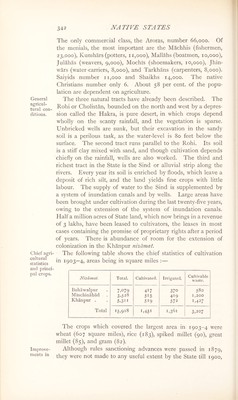
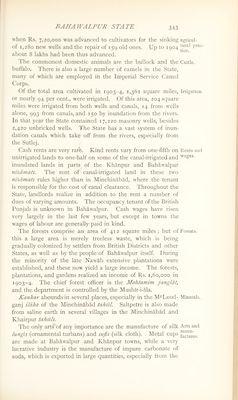
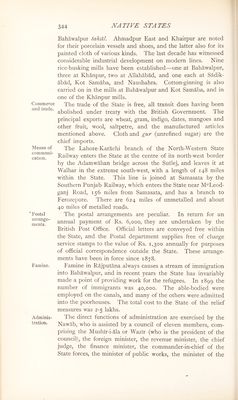
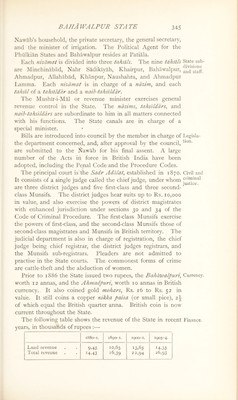
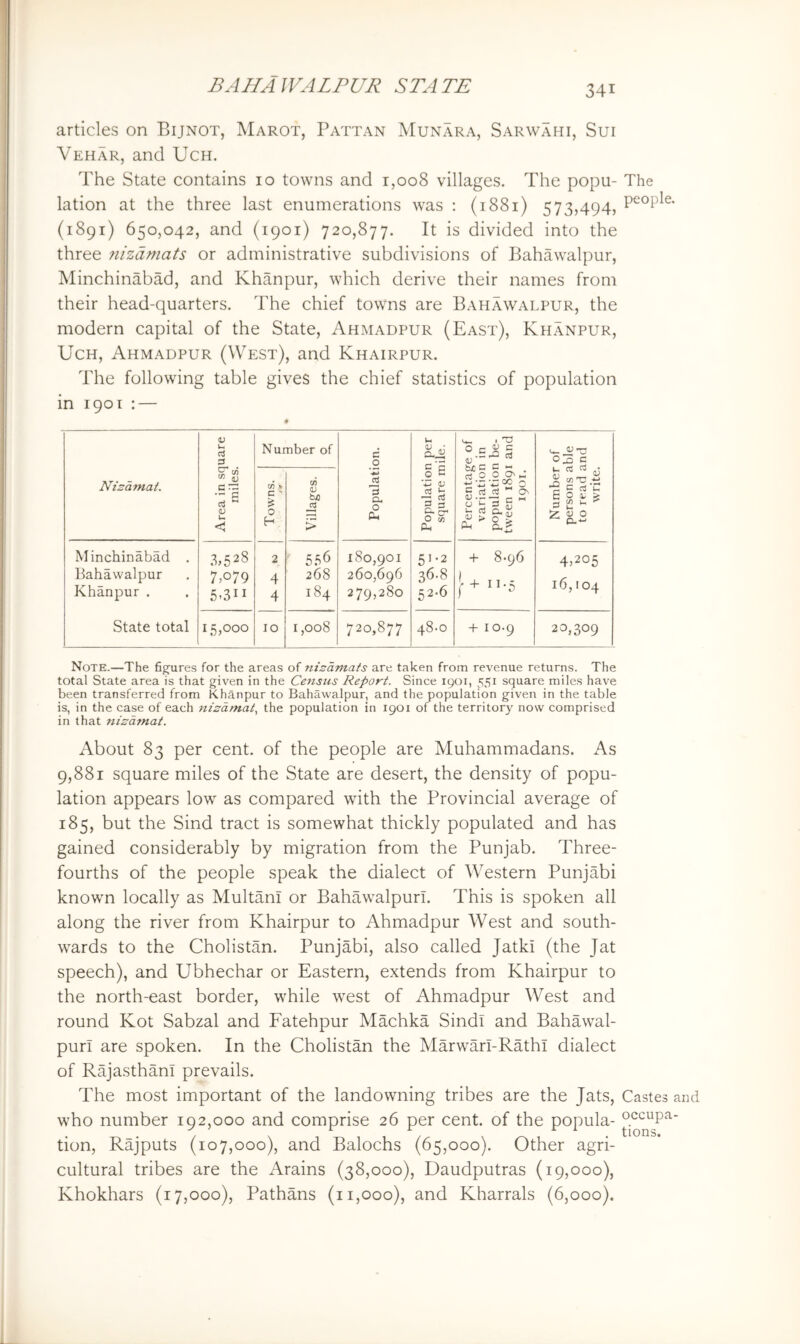
    articles on Bijnot, Marot, Pattan Munara, Sarwahi, Sui Vehar, and Uch. The State contains 10 towns and r,oo8 villages. The popu- The lation at the three last enumerations was : (1881) 573,494, (1891) 650,042, and {1901) 720,877. It is divided into the three ?iizdmats or administrative subdivisions of Bahawalpur, Minchinabad, and Khanpur, which derive their names from their head-quarters. The chief towns are Bahawalpur, the modern capital of the State, Ahmadpur (East), Khanpur, Uch, Ahmadpur (West), and Khairpur. The following table gives the chief statistics of population in 1901 : — Nizdmat. Area in square miles. Number of Population. Population per square mile. Percentage of variation in population be- tween i8gi and 1901. Number of persons able to read and write. Towns. / <r Villages. Minchinabad . Bahawalpur Khanpur . State total .P528 7,079 5,311 2 4 4 ' 556 268 184 180,901 260,696 279,280 51.2 36.8 52.6 + 8*96 \ + 11-5 4,205 16,104 15,000 10 1,008 720,877 48-0 + 10.9 20,309 Note.—The figfures for the areas of nizdmats are taken from revenue returns. The total State area is that given in the Census Report. Since 1901, 551 square miles have been transferred from Khanpur to Bahawalpur, and the population given in the table is, in the case of each nisdmat., the population in 1901 of the territory now comprised in that nizdmat. About 83 per cent, of the people are Muhammadans. As 9,88r square miles of the State are desert, the density of popu- lation appears low as compared with the Provincial average of 185, but the Sind tract is somewhat thickly populated and has gained considerably by migration from the Punjab. Three- fourths of the people speak the dialect of Western Punjabi known locally as MultanI or Bahawalpur!. This is spoken all along the river from Khairpur to Ahmadpur West and south- wards to the Cholistan. Punjabi, also called Jatki (the Jat speech), and Ubhechar or Eastern, extends from Khairpur to the north-east border, while west of Ahmadpur West and round Kot Sabzal and Fatehpur Machka Sind! and Bahawal- pur! are spoken. In the Cholistan the MarwarPRath! dialect of Rajasthan! prevails. The most important of the landowning tribes are the Jats, Castes an who number 192,000 and comprise 26 per cent, of the popula- tion, Rajputs (107,000), and Balochs (65,000). Other agri- cultural tribes are the Arains (38,000), Daudputras (19,000), Khokhars (17,000), Pathans (11,000), and Kharrals (6,000).
    page 341
    373
    page 342
    374
    page 343
    375
    page 344
    376
    page 345
    377
    page 346
    378
    Previous page
    Next page
    Wellcome Collection

    183 Euston Road
    London NW1 2BE

    +44 (0)20 7611 2222
    info@wellcomecollection.org

    • Getting here

    Today’s opening times

    • Galleries
      10:00 – 18:00
    • Library
      10:00 – 18:00
    • Café
      10:00 – 18:00
    • Shop
      10:00 – 18:00

    Opening times

    Our building has:

    • Step free access
    • Hearing loops

    Accessibility

    • Visit us
    • What’s on
    • Stories
    • Collections
    • Get involved
    • About us
    • Contact us
    • Jobs
    • Media office
    • Developers
    • Privacy and terms
    • Cookie policy
    • Manage cookies
    • Modern slavery statement
    TikTok
    Facebook
    Instagram
    YouTube

    Except where otherwise noted, content on this site is licensed under a Creative Commons Attribution 4.0 International Licence