Wellcome Collection homepage
  • Visit us
  • What’s on
  • Stories
  • Collections
  • Get involved
  • About us
Sign in to your library account
Search for anything
Library account
Take me back to the item page

Punjab.

Date:
1908
Catalogue details

Licence: In copyright

Credit: Punjab. Source: Wellcome Collection.

  • Cover
  • Title Page
  • Table of Contents
  • Index
  • Cover
    376/486 (page 344)
    Previous page
    Next page
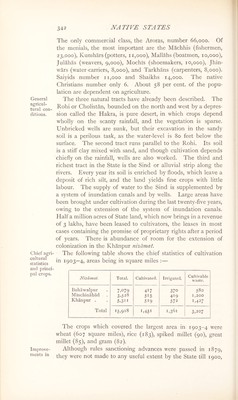
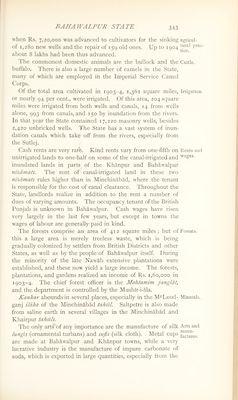
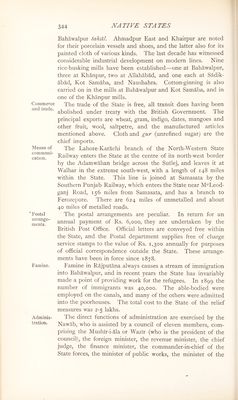
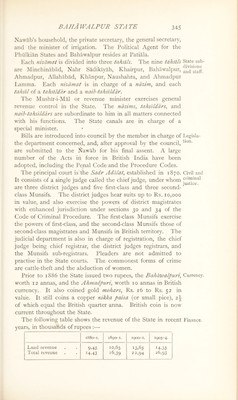
    Commerce and trade. Means of communi- cation. Postal arrange' ments. Famine. Adminis- tration. Bahawalpur tahsil. Ahmadpur East and Khairpur are noted for their porcelain vessels and shoes, and the latter also for its painted cloth of various kinds. The last decade has witnessed considerable industrial development on modern lines. Nine rice-husking mills have been established—one at Bahawalpur, three at Khanpur, two at Allahabad, and one each at Sadik- abad, Kot Samaba, and Naushahra. Cotton-ginning is also carried on in the mills at Bahawalpur and Kot Samaba, and in one of the Khanpur mills. The trade of the State is free, all transit dues having been abolished under treaty with the British Government. The principal exports are wheat, gram, indigo, dates, mangoes and other fruit, wool, saltpetre, and the manufactured articles mentioned above. Cloth and gur (unrefined sugar) are the chief imports. The Lahore-Karachi branch of the North-Western State Railway enters the State at the centre of its north-w^est border by the Adamwahan bridge across the Sutlej, and leaves it at Walhar in the extreme south-west, with a length of 148 miles within the State. This line is joined at Samasata by the Southern Punjab Railway, which enters the State near M^Leod- ganj Road, 156 miles from Samasata, and has a branch to Ferozepore. There are 624 miles of unmetalled and about 40 miles of metalled roads. The postal arrangements are peculiar. In return for an annual payment of Rs. 6,000, they are undertaken by the British Post Office. Official letters are conveyed free wuthin the State, and the Postal department supplies free of charge service stamps to the value of Rs. 1,300 annually for purposes of official correspondence outside the State. These arrange- ments have been in force since 1878. Famine in Rajputana always causes a stream of immigration into Bahawalpur, and in recent years the State has invariably made a point of providing work for the refugees. In 1899 the number of immigrants was 40,000. The able-bodied were employed on the canals, and many of the others were admitted into the poorhouses. The total cost to the State of the relief measures was 2*5 lakhs. The direct functions of administration are exercised by the Nawab, who is assisted by a council of eleven members, com- prising the Mushlr-i-ala or WazTr (who is the president of the council), the foreign minister, the revenue minister, the chief judge, the finance minister, the commander-in-chief of the State forces, the minister of public works, the minister of the
    page 341
    373
    page 342
    374
    page 343
    375
    page 344
    376
    page 345
    377
    page 346
    378
    Previous page
    Next page
    Wellcome Collection

    183 Euston Road
    London NW1 2BE

    +44 (0)20 7611 2222
    info@wellcomecollection.org

    • Getting here

    Today’s opening times

    • Galleries
      10:00 – 18:00
    • Library
      10:00 – 18:00
    • Café
      10:00 – 18:00
    • Shop
      10:00 – 18:00

    Opening times

    Our building has:

    • Step free access
    • Hearing loops

    Accessibility

    • Visit us
    • What’s on
    • Stories
    • Collections
    • Get involved
    • About us
    • Contact us
    • Jobs
    • Media office
    • Developers
    • Privacy and terms
    • Cookie policy
    • Manage cookies
    • Modern slavery statement
    TikTok
    Facebook
    Instagram
    YouTube

    Except where otherwise noted, content on this site is licensed under a Creative Commons Attribution 4.0 International Licence