Wellcome Collection homepage
  • Visit us
  • What’s on
  • Stories
  • Collections
  • Get involved
  • About us
Sign in to your library account
Search for anything
Library account
Take me back to the item page

Punjab.

Date:
1908
Catalogue details

Licence: In copyright

Credit: Punjab. Source: Wellcome Collection.

  • Cover
  • Title Page
  • Table of Contents
  • Index
  • Cover
    39/486 (page 7)
    Previous page
    Next page
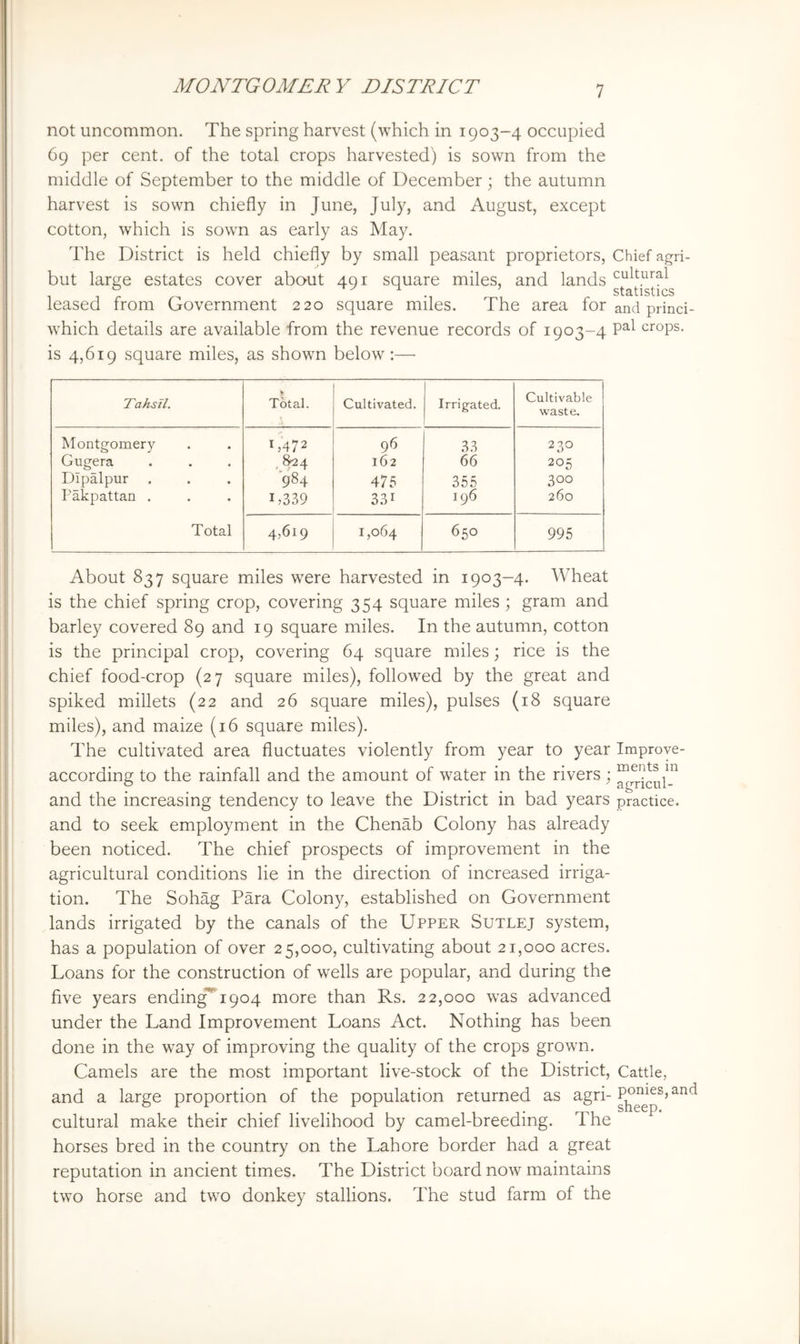
    not uncommon. The spring harvest (which in 1903-4 occupied 69 per cent, of the total crops harvested) is sown from the middle of September to the middle of December; the autumn harvest is sown chiefly in June, July, and August, except cotton, which is sown as early as May. The District is held chiefly by small peasant proprietors. Chief agri- but large estates cover abaut 491 square miles, and lands , , ^ ^ ^ statistics leased from Government 220 square miles. The area for and princi- which details are available from the revenue records of 1903-4 crops, is 4,619 square miles, as shown below:— Tahsil. Total. Cultivated. Irrigated. Cultivable waste. Montgomery L472 96 33 230 Gugera 162 66 205 Dipalpur 984 473 355 300 Pakpattan . L339 331 196 260 Total 4,619 1,064 650 995 About 837 square miles were harvested in 1903-4. Wheat is the chief spring crop, covering 354 square miles; gram and barley covered 89 and 19 square miles. In the autumn, cotton is the principal crop, covering 64 square miles; rice is the chief food-crop (27 square miles), followed by the great and spiked millets (22 and 26 square miles), pulses (18 square miles), and maize (16 square miles). The cultivated area fluctuates violently from year to year Improye- according to the rainfall and the amount of water in the rivers; and the increasing tendency to leave the District in bad years practice, and to seek employment in the Chenab Colony has already been noticed. The chief prospects of improvement in the agricultural conditions lie in the direction of increased irriga- tion. The Sohag Para Colony, established on Government lands irrigated by the canals of the Upper Sutlej system, has a population of over 25,000, cultivating about 21,000 acres. Loans for the construction of w^ells are popular, and during the five years ending 1904 more than Rs. 22,000 was advanced under the Land Improvement Loans Act. Nothing has been done in the way of improving the quality of the crops grown. Camels are the most important live-stock of the District, Cattle, and a large proportion of the population returned as agri- cultural make their chief livelihood by camel-breeding. The horses bred in the country on the Lahore border had a great reputation in ancient times. The District board now maintains two horse and two donkey stallions. The stud farm of the
    page 5
    37
    page 6
    38
    page 7
    39
    page 8
    40
    page 9
    41
    page 10
    42
    Previous page
    Next page
    Wellcome Collection

    183 Euston Road
    London NW1 2BE

    +44 (0)20 7611 2222
    info@wellcomecollection.org

    • Getting here

    Today’s opening times

    • Galleries
      10:00 – 18:00
    • Library
      10:00 – 18:00
    • Café
      10:00 – 18:00
    • Shop
      10:00 – 18:00

    Opening times

    Our building has:

    • Step free access
    • Hearing loops

    Accessibility

    • Visit us
    • What’s on
    • Stories
    • Collections
    • Get involved
    • About us
    • Contact us
    • Jobs
    • Media office
    • Developers
    • Privacy and terms
    • Cookie policy
    • Manage cookies
    • Modern slavery statement
    TikTok
    Facebook
    Instagram
    YouTube

    Except where otherwise noted, content on this site is licensed under a Creative Commons Attribution 4.0 International Licence