Wellcome Collection homepage
  • Visit us
  • What’s on
  • Stories
  • Collections
  • Get involved
  • About us
Sign in to your library account
Search for anything
Library account
Take me back to the item page

Punjab.

Date:
1908
Catalogue details

Licence: In copyright

Credit: Punjab. Source: Wellcome Collection.

  • Cover
  • Title Page
  • Table of Contents
  • Index
  • Cover
    390/486 (page 358)
    Previous page
    Next page
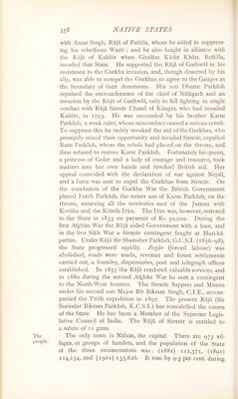
    The people. with Amar Singh, Raja of Patiala, whom he aided in suppress- ing his rebellious WazTr ; and he also fought in alliance with the Raja of Kahlur when Ghulam Kadir Khan, Rohilla, invaded that State. He supported the Raja of Garhwal in his resistance to the Gurkha invasion, and, though deserted by his ally, was able to compel the Gurkhas to agree to the Ganges as the boundary of their dominions. His son Dharm Parkash repulsed the encroachments of the chief of Nalagarh and an invasion by the Raja of Garhwal, only to fall fighting in single combat with Raja Sansar Chand of Kangra, who had invaded Kahlur, in 1793. He was succeeded by his brother Karm Parkash, a weak ruler, whose misconduct caused a serious revolt. To suppress this he rashly invoked the aid of the Gurkhas, who promptly seized their opportunity and invaded Sirmur, expelled Ratn Parkash, whom the rebels had placed on the throne, and then refused to restore Karm Paskash. Fortunately his queen, a princess of Goler and a lady of courage and resource, took matters into her own hands and invoked British aid. Her appeal coincided with the declaration of war against Nepal, and a force was sent to expel the Gurkhas from Sirmur. On the conclusion of the Gurkha War the British Government placed Fateh Parkash, the minor son of Karm Parkash, on the throne, annexing all the territories east of the Jumna with Kotaha and the Kiarda Dun. The Dun was, however, restored to the State in 1833 on payment of Rs. 50,000. During the first Afghan War the Raja aided Government with a loan, and in the first Sikh War a Sirmur contingent fought at Hari-ka- pattan. Under Raja Sir Shamsher Parkash, G.C.S.I. (1856-98), the State progressed rapidly. Begdr (forced labour) was abolished, roads were made, revenue and forest settlements carried out, a foundry, dispensaries, post and telegraph offices established. In 1857 the Raja rendered valuable services, and in 1880 during the second Afghan War he sent a contingent to the North-West frontier. The Sirmur Sappers and Miners under his second son Major Bir Bikram Singh, C.I.E., accom- panied the Tirah expedition in 1897. The present Raja (Sir Surindar Bikram Parkash, K.C.S.I.) has remodelled the courts of the State. He has been a Member of the Supreme Legis- lative Council of India. The Raja of Sirmur is entitled to a salute of 11 guns. The only town is Nahan, the capital. There are 973 vil- lages, or groups of hamlets, and the population of the State at the three enumerations was: (1881) 112,371, (1891) 124,134, and (1901) 135,626. It rose by 9-3 per cent, during
    page 353
    385
    page 354
    386
    page 355
    387
    page 356
    388
    page 357
    389
    page 358
    390
    Previous page
    Next page
    Wellcome Collection

    183 Euston Road
    London NW1 2BE

    +44 (0)20 7611 2222
    info@wellcomecollection.org

    • Getting here

    Today’s opening times

    • Galleries
      10:00 – 18:00
    • Library
      closed
    • Café
      10:00 – 18:00
    • Shop
      10:00 – 18:00

    Opening times

    Our building has:

    • Step free access
    • Hearing loops

    Accessibility

    • Visit us
    • What’s on
    • Stories
    • Collections
    • Get involved
    • About us
    • Contact us
    • Jobs
    • Media office
    • Developers
    • Privacy and terms
    • Cookie policy
    • Manage cookies
    • Modern slavery statement
    TikTok
    Facebook
    Instagram
    YouTube

    Except where otherwise noted, content on this site is licensed under a Creative Commons Attribution 4.0 International Licence