Wellcome Collection homepage
  • Visit us
  • What’s on
  • Stories
  • Collections
  • Get involved
  • About us
Sign in to your library account
Search for anything
Library account
Take me back to the item page

Punjab.

Date:
1908
Catalogue details

Licence: In copyright

Credit: Punjab. Source: Wellcome Collection.

  • Cover
  • Title Page
  • Table of Contents
  • Index
  • Cover
    394/486 (page 362)
    Previous page
    Next page
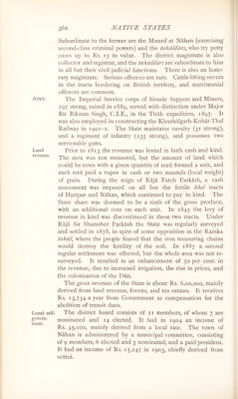
    Army. Land revenue. Local self- govern- ment. Subordinate to the former are the Munsif at Nahan (exercising second-class criminal powers) and the tahsllddrs^ who try petty cases up to Rs. 15 in value. The district magistrate is also collector and registrar, and the tahsllddrs are subordinate to him in all but their civil judicial functions. There is also an hono- rary magistrate. Serious offences are rare. Cattle-lifting occurs in the tracts bordering on British territory, and matrimonial offences are common. The Imperial Service corps of Sirmur Sappers and Miners, 197 strong, raised in 1889, served with distinction under Major Bir Bikram Singh, C.I.E., in the Tirah expedition, 1897. It was also employed in constructing the Khushalgarh-Kohat-Thal Railway in 1901-2. The State maintains cavalry (31 strong), and a regiment of infantry (235 strong), and possesses two serviceable guns. Prior to 1813 the revenue was levied in both cash and kind. The area was not measured, but the amount of land which could be sown with a given quantity of seed formed a unit, and each unit paid a rupee in cash or two maunds (local weight) of grain. During the reign of Raja Fateh Parkash, a cash assessment was imposed on all but the fertile khol tracts of Harlpur and Nahan, which continued to pay in kind. The State share was deemed to be a sixth of the gross produce, with an additional cess on each unit. In 1845 the levy of revenue in kind was discontinued in these two tracts. Under Raja Sir Shamsher Parkash the State was regularly surveyed and settled in 1878, in spite of some opposition in the Rainka tahsll^ where the people feared that the iron measuring chains would destroy the fertility of the soil. In 1887 a second regular settlement was effected, but the whole area was not re- surveyed. It resulted in an enhancement of 50 per cent, in the revenue, due to increased irrigation, the rise in prices, and the colonization of the Dun. The gross revenue of the State is about Rs. 6,00,000, mainly derived from land revenue, forests, and tea estates. It receives Rs. 13,734 ^ from Government as compensation for the abolition of transit dues. The district board consists of 21 members, of whom 7 are nominated and 14 elected. It had in 1904 an income of Rs. 45,000, mainly derived from a local rate. The town of Nahan is administered by a municipal committee, consisting of 9 members, 6 elected and 3 nominated, and a paid president. It had an income of Rs. 15,247 in 1903, chiefly derived from octroi.
    page 359
    391
    page 360
    392
    page 361
    393
    page 362
    394
    page 363
    395
    page 364
    396
    Previous page
    Next page

    Wellcome Collection

    183 Euston Road
    London NW1 2BE

    +44 (0)20 7611 2222
    info@wellcomecollection.org

    • Getting here

    Today’s opening times

    • Galleries
      10:00 – 18:00
    • Library
      closed
    • Café
      10:00 – 18:00
    • Shop
      10:00 – 18:00

    Opening times

    Our building has:

    • Step free access
    • Hearing loops

    Accessibility

    • Visit us
    • What’s on
    • Stories
    • Collections
    • Get involved
    • About us
    • Contact us
    • Jobs
    • Media office
    • Developers
    • Privacy and terms
    • Cookie policy
    • Manage cookies
    • Modern slavery statement
    TikTok
    Facebook
    Instagram
    YouTube

    Except where otherwise noted, content on this site is licensed under a Creative Commons Attribution 4.0 International Licence