Wellcome Collection homepage
  • Visit us
  • What’s on
  • Stories
  • Collections
  • Get involved
  • About us
Sign in to your library account
Search for anything
Library account
Take me back to the item page

Punjab.

Date:
1908
Catalogue details

Licence: In copyright

Credit: Punjab. Source: Wellcome Collection.

  • Cover
  • Title Page
  • Table of Contents
  • Index
  • Cover
    398/486 (page 366)
    Previous page
    Next page
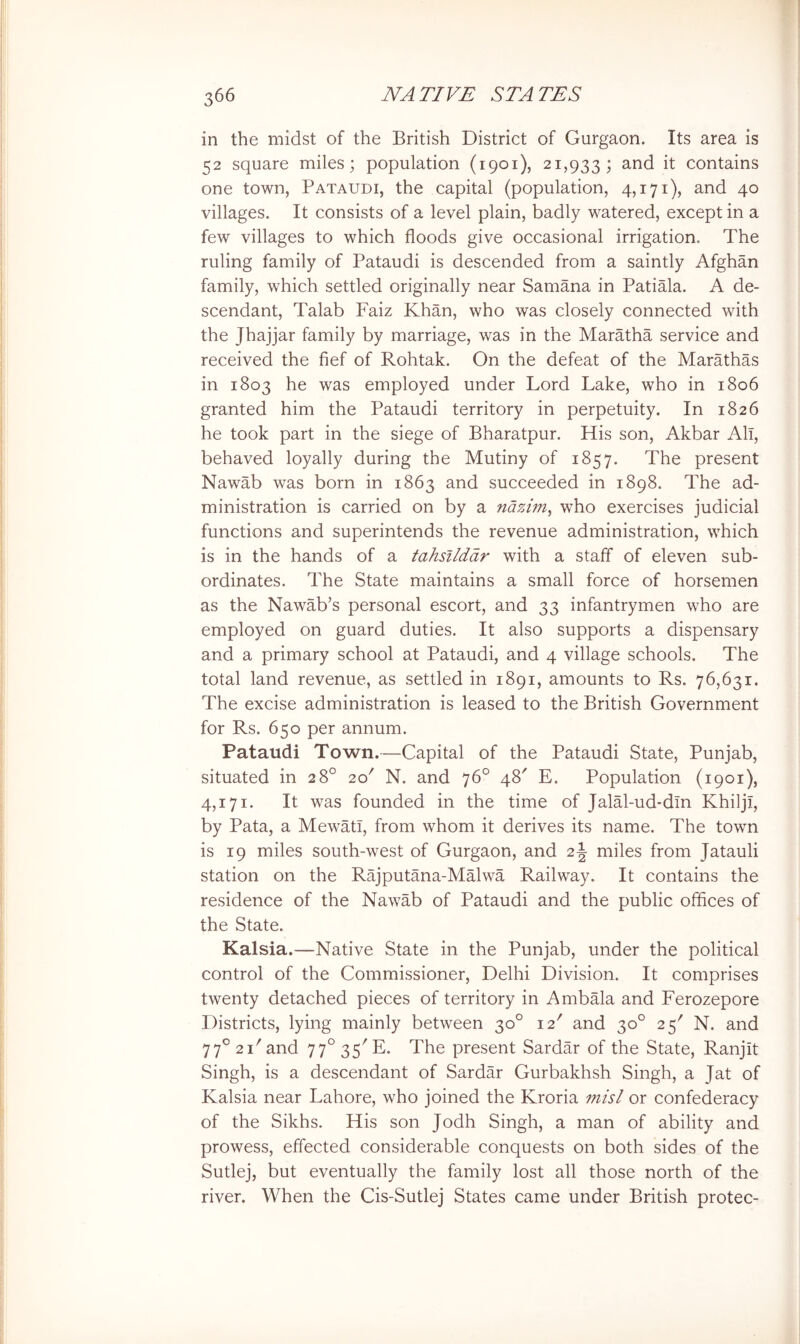
    in the midst of the British District of Gurgaon. Its area is 52 square miles; population (1901), 21,933; and it contains one town, Pataudi, the capital (population, 4,171), and 40 villages. It consists of a level plain, badly watered, except in a few villages to which floods give occasional irrigation. The ruling family of Pataudi is descended from a saintly Afghan family, which settled originally near Samana in Patiala. A de- scendant, Talab Faiz Khan, who was closely connected with the Jhajjar family by marriage, was in the Maratha service and received the fief of Rohtak. On the defeat of the Marathas in 1803 he was employed under Lord Lake, who in 1806 granted him the Pataudi territory in perpetuity. In 1826 he took part in the siege of Bharatpur. His son, Akbar All, behaved loyally during the Mutiny of 1857. The present Nawab was born in 1863 and succeeded in 1898. The ad- ministration is carried on by a nazim^ who exercises judicial functions and superintends the revenue administration, which is in the hands of a tahsllddr with a staff of eleven sub- ordinates. The State maintains a small force of horsemen as the Nawab’s personal escort, and 33 infantrymen who are employed on guard duties. It also supports a dispensary and a primary school at Pataudi, and 4 village schools. The total land revenue, as settled in 1891, amounts to Rs. 76,631. The excise administration is leased to the British Government for Rs. 650 per annum. Pataudi Town.—Capital of the Pataudi State, Punjab, situated in 28° 20' N. and 76° 48' E. Population (1901), 4,171. It was founded in the time of Jalal-ud-dln Khiljl, by Pata, a Mewatl, from whom it derives its name. The town is 19 miles south-west of Gurgaon, and 2J miles from Jatauli station on the Rajputana-Malwa Railway. It contains the residence of the Nawab of Pataudi and the public offices of the State. Kalsia.—Native State in the Punjab, under the political control of the Commissioner, Delhi Division. It comprises twenty detached pieces of territory in Ambffia and Ferozepore Districts, lying mainly between 30° 12' and 30° 25' N. and 77° 21'and 77°35'E. The present Sardffi of the State, Ranjit Singh, is a descendant of Sardar Gurbakhsh Singh, a Jat of Kalsia near Lahore, who joined the Kroria misl or confederacy of the Sikhs. His son Jodh Singh, a man of ability and prowess, effected considerable conquests on both sides of the Sutlej, but eventually the family lost all those north of the river. When the Cis-Sutlej States came under British protec-
    page 365
    397
    page 366
    398
    page 367
    399
    page 368
    400
    page 369
    401
    page 370
    402
    Previous page
    Next page
    Wellcome Collection

    183 Euston Road
    London NW1 2BE

    +44 (0)20 7611 2222
    info@wellcomecollection.org

    • Getting here

    Today’s opening times

    • Galleries
      10:00 – 18:00
    • Library
      closed
    • Café
      10:00 – 18:00
    • Shop
      10:00 – 18:00

    Opening times

    Our building has:

    • Step free access
    • Hearing loops

    Accessibility

    • Visit us
    • What’s on
    • Stories
    • Collections
    • Get involved
    • About us
    • Contact us
    • Jobs
    • Media office
    • Developers
    • Privacy and terms
    • Cookie policy
    • Manage cookies
    • Modern slavery statement
    TikTok
    Facebook
    Instagram
    YouTube

    Except where otherwise noted, content on this site is licensed under a Creative Commons Attribution 4.0 International Licence