Wellcome Collection homepage
  • Visit us
  • What’s on
  • Stories
  • Collections
  • Get involved
  • About us
Sign in to your library account
Search for anything
Library account
Take me back to the item page

Punjab.

Date:
1908
Catalogue details

Licence: In copyright

Credit: Punjab. Source: Wellcome Collection.

  • Cover
  • Title Page
  • Table of Contents
  • Index
  • Cover
    401/486 (page 369)
    Previous page
    Next page
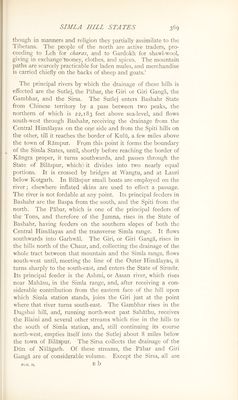
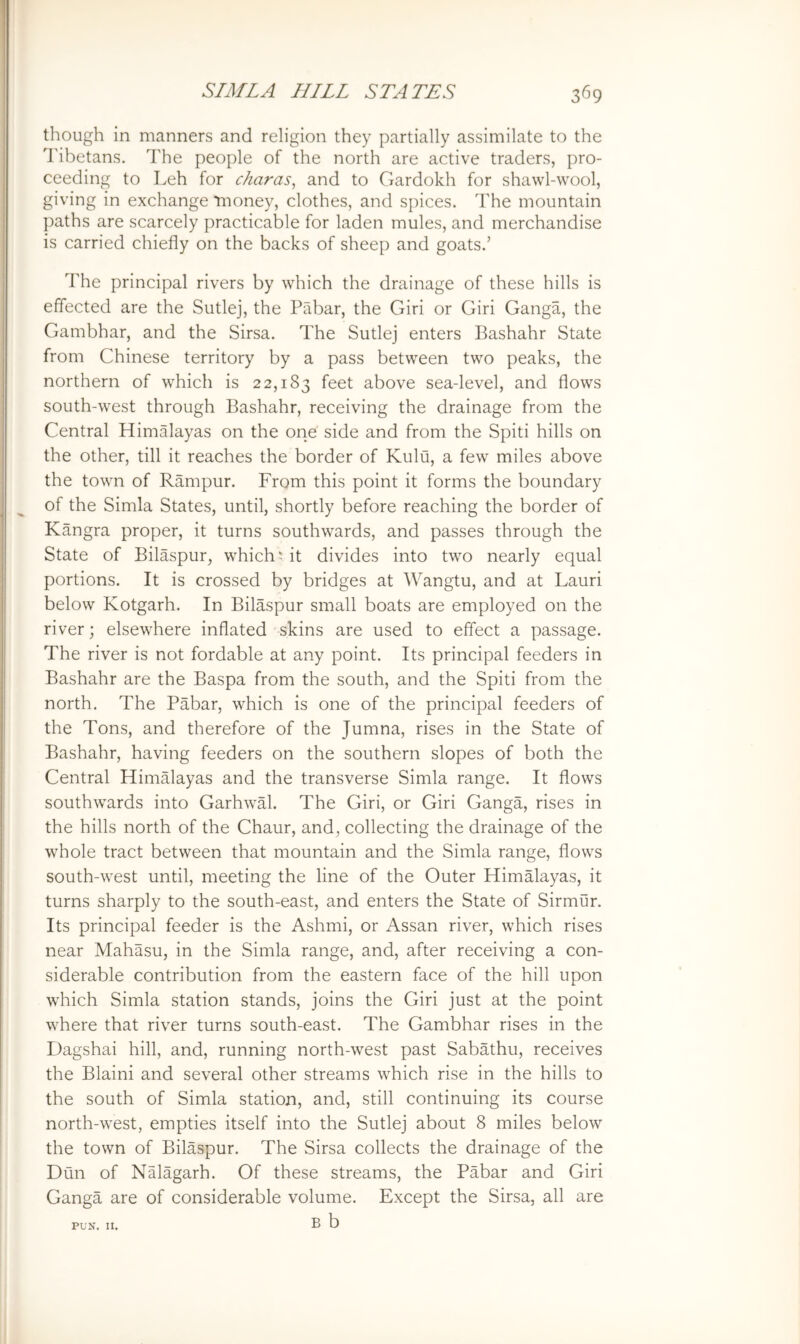
    though in manners and religion they partially assimilate to the d'ibetans. The people of the north are active traders, pro- ceeding to Leh for charas, and to Gardokh for shawl-wool, giving in exchange money, clothes, and spices. The mountain paths are scarcely practicable for laden mules, and merchandise is carried chiefly on the backs of sheep and goats.’ The principal rivers by which the drainage of these hills is effected are the Sutlej, the Pabar, the Giri or Giri Ganga, the Gambhar, and the Sirsa. The Sutlej enters Bashahr State from Chinese territory by a pass between two peaks, the northern of which is 22,183 above sea-level, and flows south-west through Bashahr, receiving the drainage from the Central Himalayas on the one side and from the Spiti hills on the other, till it reaches the border of Kulu, a few miles above the town of Rampur. From this point it forms the boundary of the Simla States, until, shortly before reaching the border of Kangra proper, it turns southwards, and passes through the State of Bilaspur, which i it divides into two nearly equal portions. It is crossed by bridges at Wangtu, and at Lauri below Kotgarh. In Bilaspur small boats are employed on the river; elsewhere inflated skins are used to effect a passage. The river is not fordable at any point. Its principal feeders in Bashahr are the Baspa from the south, and the Spiti from the north. The Pabar, which is one of the principal feeders of the Tons, and therefore of the Jumna, rises in the State of Bashahr, having feeders on the southern slopes of both the Central Himalayas and the transverse Simla range. It flows southwards into Garhwal. The Giri, or Giri Ganga, rises in the hills north of the Chaur, and, collecting the drainage of the whole tract between that mountain and the Simla range, flows south-west until, meeting the line of the Outer Himalayas, it turns sharply to the south-east, and enters the State of Sirmur. Its principal feeder is the Ashmi, or Assan river, which rises near Mahasu, in the Simla range, and, after receiving a con- siderable contribution from the eastern face of the hill upon which Simla station stands, joins the Giri just at the point where that river turns south-east. The Gambhar rises in the Dagshai hill, and, running north-west past Sabathu, receives the Blaini and several other streams which rise in the hills to the south of Simla station, and, still continuing its course north-west, empties itself into the Sutlej about 8 miles below the town of Bilaspur. The Sirsa collects the drainage of the Dun of Nalagarh. Of these streams, the Pabar and Giri Ganga are of considerable volume. Except the Sirsa, all are B b PUN. II.
    page 365
    397
    page 366
    398
    page 367
    399
    page 368
    400
    page 369
    401
    page 370
    402
    Previous page
    Next page
    Wellcome Collection

    183 Euston Road
    London NW1 2BE

    +44 (0)20 7611 2222
    info@wellcomecollection.org

    • Getting here

    Today’s opening times

    • Galleries
      10:00 – 18:00
    • Library
      closed
    • Café
      10:00 – 18:00
    • Shop
      10:00 – 18:00

    Opening times

    Our building has:

    • Step free access
    • Hearing loops

    Accessibility

    • Visit us
    • What’s on
    • Stories
    • Collections
    • Get involved
    • About us
    • Contact us
    • Jobs
    • Media office
    • Developers
    • Privacy and terms
    • Cookie policy
    • Manage cookies
    • Modern slavery statement
    TikTok
    Facebook
    Instagram
    YouTube

    Except where otherwise noted, content on this site is licensed under a Creative Commons Attribution 4.0 International Licence