Wellcome Collection homepage
  • Visit us
  • What’s on
  • Stories
  • Collections
  • Get involved
  • About us
Sign in to your library account
Search for anything
Library account
Take me back to the item page

Punjab.

Date:
1908
Catalogue details

Licence: In copyright

Credit: Punjab. Source: Wellcome Collection.

  • Cover
  • Title Page
  • Table of Contents
  • Index
  • Cover
    405/486 (page 373)
    Previous page
    Next page
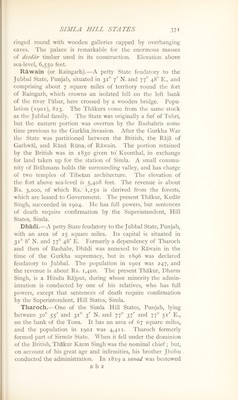
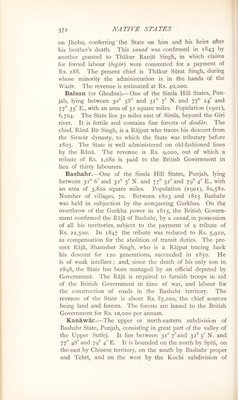
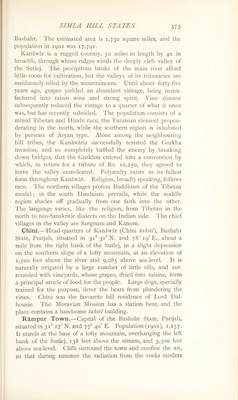
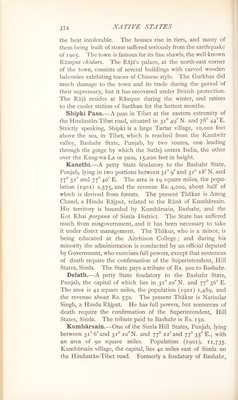
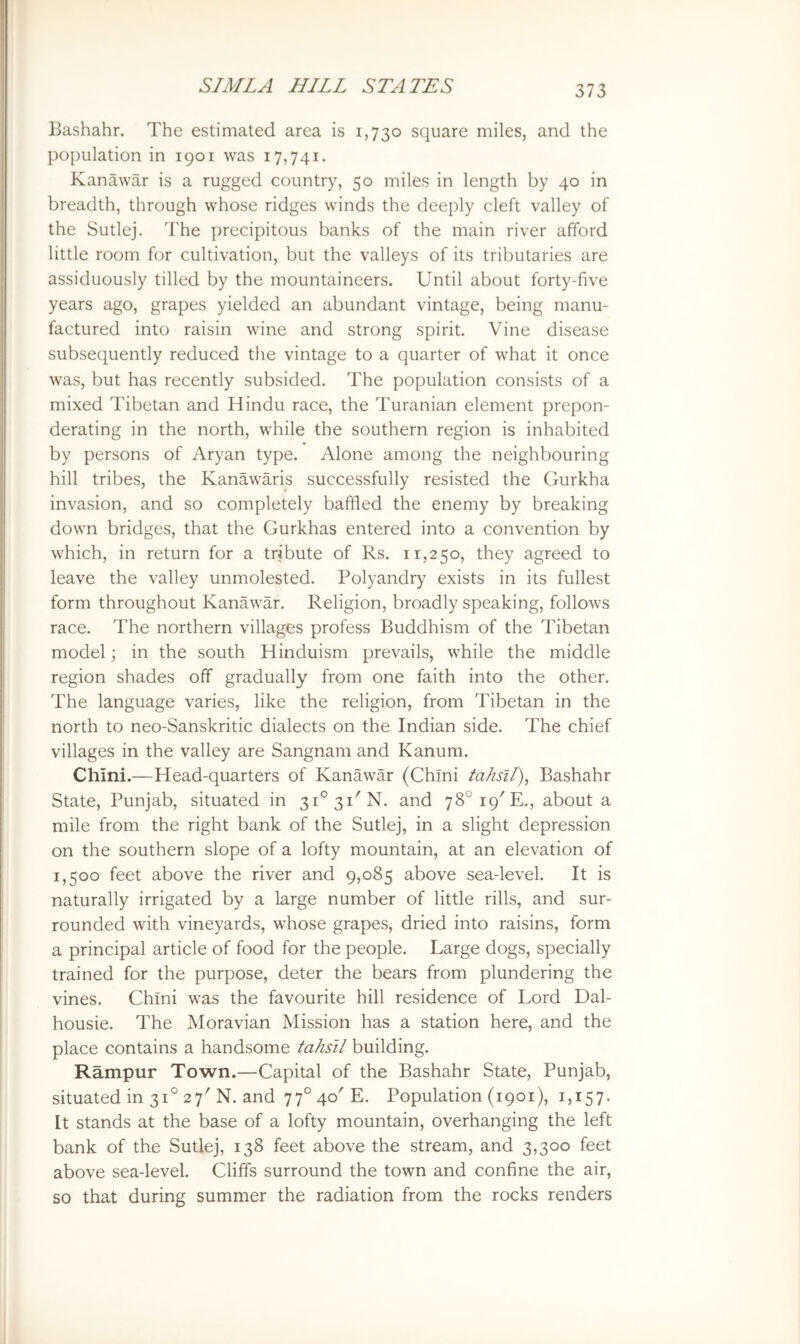
    Bashahr. The estimated area is 1,730 square miles, and the population in 1901 was 17,741. Kanawar is a rugged country, 50 miles in length by 40 in breadth, through whose ridges winds the deeply cleft valley of the Sutlej. The precipitous banks of the main river afford little room for cultivation, but the valleys of its tributaries are assiduously tilled by the mountaineers. Until about forty-five years ago, grapes yielded an abundant vintage, being manu- factured into raisin wine and strong spirit. Vine disease subsequently reduced the vintage to a quarter of what it once was, but has recently subsided. The population consists of a mixed Tibetan and Hindu race, the Turanian element prepon- derating in the north, while the southern region is inhabited by persons of Aryan type. Alone among the neighbouring hill tribes, the Kanawaris successfully resisted the Gurkha invasion, and so completely baffled the enemy by breaking down bridges, that the Gurkhas entered into a convention by which, in return for a tribute of Rs. 11,250, they agreed to leave the valley unmolested. Polyandry exists in its fullest form throughout Kanawar. Religion, broadly speaking, follows race. The northern villages profess Buddhism of the Tibetan model; in the south Hinduism prevails, while the middle region shades off gradually from one faith into the other. The language varies, like the religion, from Tibetan in the north to neo-Sanskritic dialects on the Indian side. The chief villages in the valley are Sangnam and Kanum. Chini.—Head-quarters of Kanawar (Chini tahsil)^ Bashahr State, Punjab, situated in 3i°3i'N. and 78°i9'E., about a mile from the right bank of the Sutlej, in a slight depression on the southern slope of a lofty mountain, at an elevation of 1,500 feet above the river and 9,085 above sea-level. It is naturally irrigated by a large number of little rills, and sur- rounded with vineyards, whose grapes, dried into raisins, form a principal article of food for the people. Large dogs, specially trained for the purpose, deter the bears from plundering the vines. Chini was the favourite hill residence of Lord Dal- housie. The Moravian Mission has a station here, and the place contains a handsome tahsil building. Rampur Town.—Capital of the Bashahr State, Punjab, situated in 31° 27' N. and 77° 40' E. Population (1901), 1,157. It stands at the base of a lofty mountain, overhanging the left bank of the Sutlej, 138 feet above the stream, and 3,300 feet above sea-level. Cliffs surround the town and confine the air, so that during summer the radiation from the rocks renders
    page 371
    403
    page 372
    404
    page 373
    405
    page 374
    406
    page 375
    407
    page 376
    408
    Previous page
    Next page
    Wellcome Collection

    183 Euston Road
    London NW1 2BE

    +44 (0)20 7611 2222
    info@wellcomecollection.org

    • Getting here

    Today’s opening times

    • Galleries
      10:00 – 18:00
    • Library
      closed
    • Café
      10:00 – 18:00
    • Shop
      10:00 – 18:00

    Opening times

    Our building has:

    • Step free access
    • Hearing loops

    Accessibility

    • Visit us
    • What’s on
    • Stories
    • Collections
    • Get involved
    • About us
    • Contact us
    • Jobs
    • Media office
    • Developers
    • Privacy and terms
    • Cookie policy
    • Manage cookies
    • Modern slavery statement
    TikTok
    Facebook
    Instagram
    YouTube

    Except where otherwise noted, content on this site is licensed under a Creative Commons Attribution 4.0 International Licence