Wellcome Collection homepage
  • Visit us
  • What’s on
  • Stories
  • Collections
  • Get involved
  • About us
Sign in to your library account
Search for anything
Library account
Take me back to the item page

Punjab.

Date:
1908
Catalogue details

Licence: In copyright

Credit: Punjab. Source: Wellcome Collection.

  • Cover
  • Title Page
  • Table of Contents
  • Index
  • Cover
    412/486 (page 380)
    Previous page
    Next page
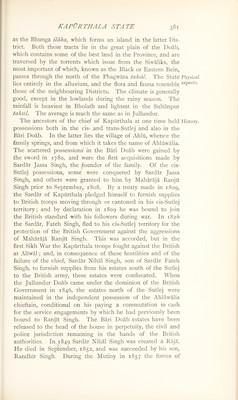
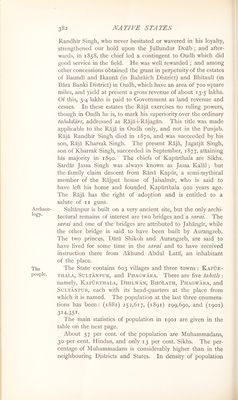
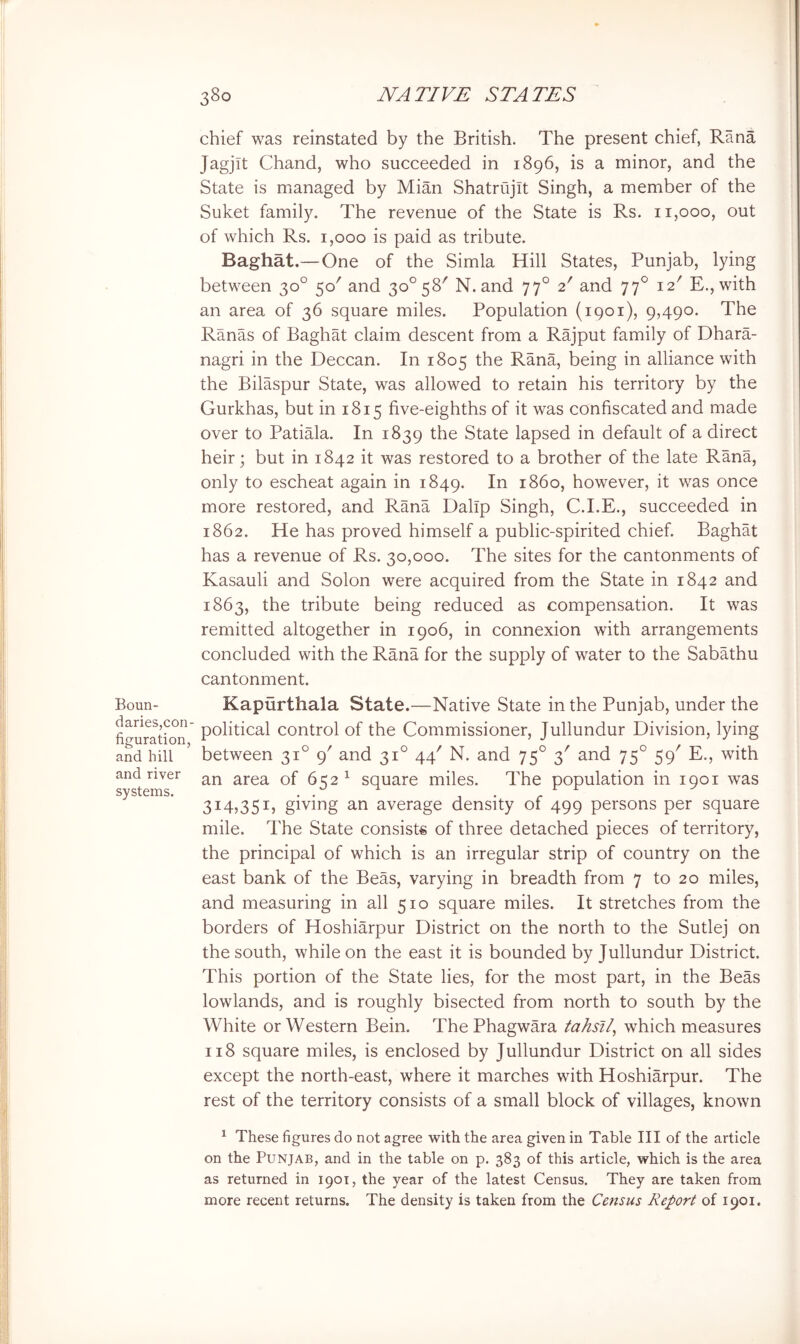
    Boun- daries,con- figuration, and hill and river systems. chief was reinstated by the British. The present chief, Rana Jagjit Chand, who succeeded in 1896, is a minor, and the State is managed by Mian Shatrujit Singh, a member of the Suket family. The revenue of the State is Rs. 11,000, out of which Rs. 1,000 is paid as tribute. Baghat.— One of the Simla Hill States, Punjab, lying between 30° 50' and 30^58' N. and 77° 2' and 77° 12' E.,with an area of 36 square miles. Population (iqoi), 9,490. The Ranas of Baghat claim descent from a Rajput family of Dhara- nagri in the Deccan. In 1805 the Rana, being in alliance with the Bilaspur State, was allowed to retain his territory by the Gurkhas, but in 1815 five-eighths of it was confiscated and made over to Patiala. In 1839 the State lapsed in default of a direct heir; but in 1842 it was restored to a brother of the late Rana, only to escheat again in 1849. In i860, however, it was once more restored, and Rana Dalip Singh, C.I.E., succeeded in 1862. He has proved himself a public-spirited chief. Baghat has a revenue of Rs. 30,000. The sites for the cantonments of Kasauli and Solon were acquired from the State in 1842 and 1863, the tribute being reduced as compensation. It was remitted altogether in 1906, in connexion with arrangements concluded with the Rana for the supply of water to the Sabathu cantonment. Kapurthala State.—Native State in the Punjab, under the political control of the Commissioner, Jullundur Division, lying between 31° 9' and 31° 44' N. and 75° 3' and 75° 59' E., with an area of 652 ^ square miles. The population in 1901 was 314,351, giving an average density of 499 persons per square mile. The State consists of three detached pieces of territory, the principal of which is an irregular strip of country on the east bank of the Beas, varying in breadth from 7 to 20 miles, and measuring in all 510 square miles. It stretches from the borders of Hoshiarpur District on the north to the Sutlej on the south, while on the east it is bounded by Jullundur District. This portion of the State lies, for the most part, in the Beas lowlands, and is roughly bisected from north to south by the White or Western Bein. ThePhagwara tahsf/, which measures 118 square miles, is enclosed by Jullundur District on all sides except the north-east, where it marches with Hoshiarpur. The rest of the territory consists of a small block of villages, known ^ These figures do not agree with the area given in Table III of the article on the Punjab, and in the table on p. 383 of this article, which is the area as returned in 1901, the year of the latest Census. They are taken from more recent returns. The density is taken from the Census Report of 1901.
    page 377
    409
    page 378
    410
    page 379
    411
    page 380
    412
    page 381
    413
    page 382
    414
    Previous page
    Next page
    Wellcome Collection

    183 Euston Road
    London NW1 2BE

    +44 (0)20 7611 2222
    info@wellcomecollection.org

    • Getting here

    Today’s opening times

    • Galleries
      10:00 – 18:00
    • Library
      closed
    • Café
      10:00 – 18:00
    • Shop
      10:00 – 18:00

    Opening times

    Our building has:

    • Step free access
    • Hearing loops

    Accessibility

    • Visit us
    • What’s on
    • Stories
    • Collections
    • Get involved
    • About us
    • Contact us
    • Jobs
    • Media office
    • Developers
    • Privacy and terms
    • Cookie policy
    • Manage cookies
    • Modern slavery statement
    TikTok
    Facebook
    Instagram
    YouTube

    Except where otherwise noted, content on this site is licensed under a Creative Commons Attribution 4.0 International Licence