Wellcome Collection homepage
  • Visit us
  • What’s on
  • Stories
  • Collections
  • Get involved
  • About us
Sign in to your library account
Search for anything
Library account
Take me back to the item page

Punjab.

Date:
1908
Catalogue details

Licence: In copyright

Credit: Punjab. Source: Wellcome Collection.

  • Cover
  • Title Page
  • Table of Contents
  • Index
  • Cover
    414/486 (page 382)
    Previous page
    Next page
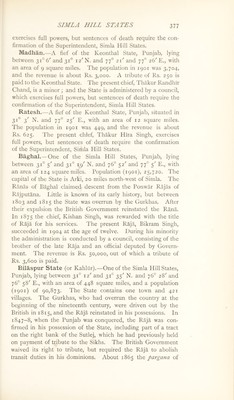
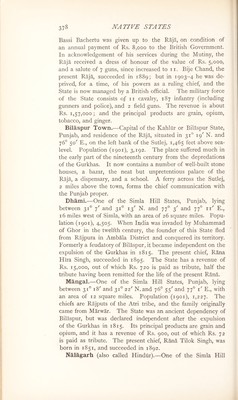
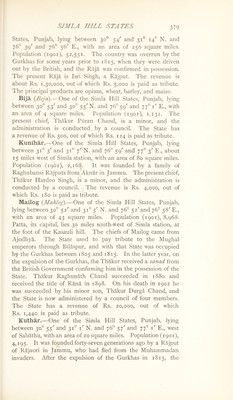
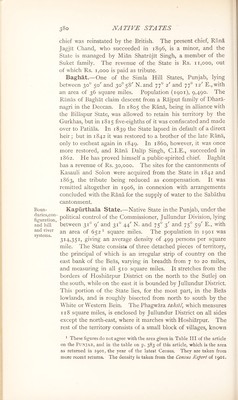
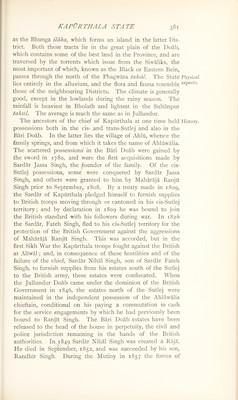
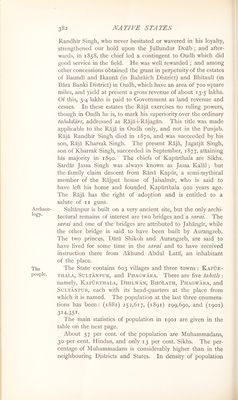
    Archaeo- logy. The people. RandhTr Singh, who never hesitated or wavered in his loyalty, strengthened our hold upon the Jullundur Doab; and after- wards, in 1858, the chief led a contingent to Oudh which did good service in the field. He was well rewarded ; and among other concessions obtained the grant in perpetuity of the estates of Baundl and Ikauna (in Bahraich District) and Bhitaull (in Bara Banki District) in Oudh, which have an area of 700 square miles, and yield at present a gross revenue of about 13*5 lakhs. Of this, 3*4 lakhs is paid to Government as land revenue and cesses. In these estates the Raja exercises no ruling powers, though in Oudh he is, to mark his superiority over the ordinary talukddrs^ addressed as Raja-i-Rajagan. This title was made applicable to the Raja in Oudh only, and not in the Punjab. Raja Randhir Singh died in 1870, and was succeeded by his son. Raja Kharrak Singh. The present Raja, Jagatjit Singh, son of Kharrak Singh, succeeded in September, 1877, attaining his majority in 1890. The chiefs of Kapurthala are Sikhs. Sardar Jassa Singh was always known as Jassa Kalal; but the family claim descent from Rana Kapur, a semi-mythical member of the Rajput house of Jaisalmir, who is said to have left his home and founded Kapurthala 900 years ago. The Raja has the right of adoption and is entitled to a salute of n guns. Sultanpur is built on a very ancient site, but the only archi- tectural remains of interest are two bridges and a sarai. The sarai and one of the bridges are attributed to Jahangir, while the other bridge is said to have been built by Aurangzeb. The two princes, Dara Shikoh and Aurangzeb, are said to have lived for some time in the sa7'ai and to have received instruction there from Akhund Abdul Latif, an inhabitant of the place. The State contains 603 villages and three towns ; Kapur- thala, Sultanpur, and Phagwara. There are five tahsils : namely, Kapurthala, Dhilwan, Bholath, Phagwara, and Sultanpur, each with its head-quarters at the place from which it is named. The population at the last three enumera- tions has been: (1881) 252,617, (1891) 299,690, and (1901) 314,351- The main statistics of population in 1901 are given in the table on the next page. About 57 per cent, of the population are Muhammadans, 30 per cent. Hindus, and only 13 per cent. Sikhs. The per- centage of Muhammadans is considerably higher than in the neighbouring Districts and States. In density of population
    page 377
    409
    page 378
    410
    page 379
    411
    page 380
    412
    page 381
    413
    page 382
    414
    Previous page
    Next page
    Wellcome Collection

    183 Euston Road
    London NW1 2BE

    +44 (0)20 7611 2222
    info@wellcomecollection.org

    • Getting here

    Today’s opening times

    • Galleries
      10:00 – 18:00
    • Library
      closed
    • Café
      10:00 – 18:00
    • Shop
      10:00 – 18:00

    Opening times

    Our building has:

    • Step free access
    • Hearing loops

    Accessibility

    • Visit us
    • What’s on
    • Stories
    • Collections
    • Get involved
    • About us
    • Contact us
    • Jobs
    • Media office
    • Developers
    • Privacy and terms
    • Cookie policy
    • Manage cookies
    • Modern slavery statement
    TikTok
    Facebook
    Instagram
    YouTube

    Except where otherwise noted, content on this site is licensed under a Creative Commons Attribution 4.0 International Licence