Wellcome Collection homepage
  • Visit us
  • What’s on
  • Stories
  • Collections
  • Get involved
  • About us
Sign in to your library account
Search for anything
Library account
Take me back to the item page

Punjab.

Date:
1908
Catalogue details

Licence: In copyright

Credit: Punjab. Source: Wellcome Collection.

  • Cover
  • Title Page
  • Table of Contents
  • Index
  • Cover
    416/486 (page 384)
    Previous page
    Next page
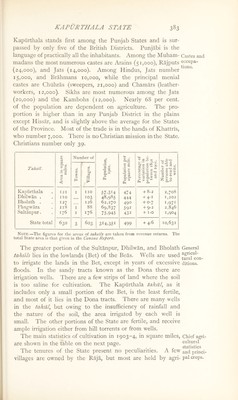
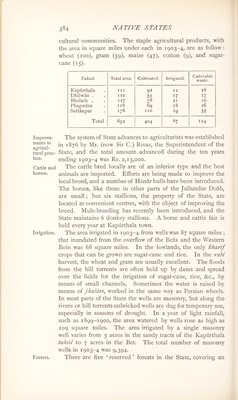
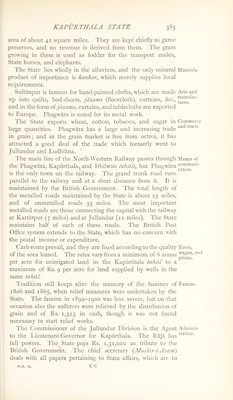
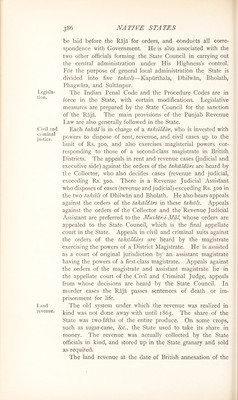
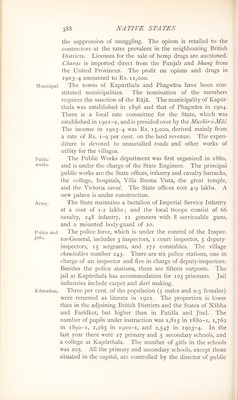
    cultural communities. The staple agricultural products, with the area in square miles under each in 1903-4, are as follow : wheat (200), gram (59), maize (47), cotton (9), and sugar- cane (15). Tahstl. Total area. Cultivated. Irrigated. Cultivable waste. Kapurthala 121 92 1 2 16 Dhilwan . 110 55 17 17 Bholath . 127 78 21 10 Phagwara I18 69 18 26 Sultanpur 176 no 19 55 Total 652 404 00 124 Improve- ments in agricul- tural prac- tice. Cattle and horses. Irrigation. Forests. The system of State advances to agriculturists was established in 1876 by Mr. (now Sir C.) Rivaz, the Superintendent of the State, and the total amount advanced during the ten years ending 1903-4 was Rs. 2,13,000. The cattle bred locally are of an inferior type and the best animals are imported. Efforts are being made to improve the local breed, and a number of Hissar bulls have been introduced. The horses, like those in other parts of the Jullundur Doab, are small; but six stallions, the property of the State, are located at convenient centres, with the object of improving the breed. Mule-breeding has recently been introduced, and the State maintains 6 donkey stallions. A horse and cattle fair is held every year at Kapurthala town. The area irrigated in 1903-4 from wells was 87 square miles ; that inundated from the overflow of the Beas and the Western Bein was 68 square miles. In the lowlands, the only kharif crops that can be grown are sugar-cane and rice. In the rahi harvest, the wheat and gram are usually excellent. The floods from the hill torrents are often held up by dams and spread over the fields for the irrigation of sugar-cane, rice, &c., by means of small channels. Sometimes the water is raised by means of jhaldrs^ worked in the same way as Persian wheels. In most parts of the State the wells are masonry, but along the rivers or hill torrents unbricked wells are dug for temporary use, especially in seasons of drought. In a year of light rainfall, such as 1899-1900, the area watered by wells rose as high as 109 square miles. The area irrigated by a single masonry well varies from 5 acres in the sandy tracts of the Kapurthala tahsll to 7 acres in the Bet. The total number of masonry wells in 1903-4 was 9,394. There are five ‘ reserved ’ forests in the State, covering an
    page 383
    415
    page 384
    416
    page 385
    417
    page 386
    418
    page 387
    419
    page 388
    420
    Previous page
    Next page
    Wellcome Collection

    183 Euston Road
    London NW1 2BE

    +44 (0)20 7611 2222
    info@wellcomecollection.org

    • Getting here

    Today’s opening times

    • Galleries
      10:00 – 18:00
    • Library
      10:00 – 16:00
    • Café
      10:00 – 18:00
    • Shop
      10:00 – 18:00

    Opening times

    Our building has:

    • Step free access
    • Hearing loops

    Accessibility

    • Visit us
    • What’s on
    • Stories
    • Collections
    • Get involved
    • About us
    • Contact us
    • Jobs
    • Media office
    • Developers
    • Privacy and terms
    • Cookie policy
    • Manage cookies
    • Modern slavery statement
    TikTok
    Facebook
    Instagram
    YouTube

    Except where otherwise noted, content on this site is licensed under a Creative Commons Attribution 4.0 International Licence