Wellcome Collection homepage
  • Visit us
  • What’s on
  • Stories
  • Collections
  • Get involved
  • About us
Sign in to your library account
Search for anything
Library account
Take me back to the item page

Punjab.

Date:
1908
Catalogue details

Licence: In copyright

Credit: Punjab. Source: Wellcome Collection.

  • Cover
  • Title Page
  • Table of Contents
  • Index
  • Cover
    417/486 (page 385)
    Previous page
    Next page
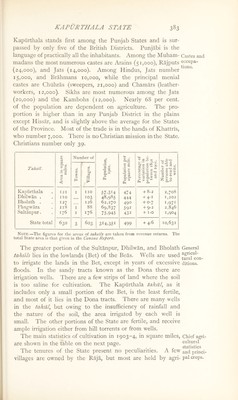
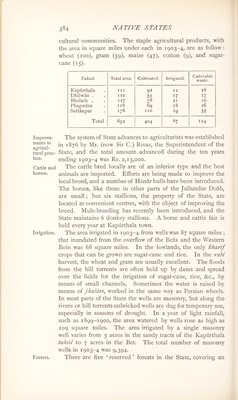
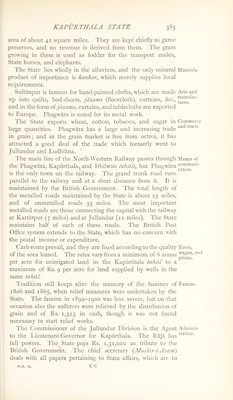
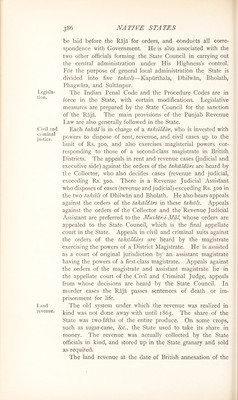
    area of about 42 square miles. They are kept chiefly as game preserves, and no revenue is derived from them. The grass growing in them is used as fodder for the transport mules, State horses, and elephants. The State lies wholly in the alluvium, and the only mineral Minerals, product of importance is ka?ikar^ which merely supplies local requirements. Sultanpur is famous for hand-painted cloths, which are made Arts and up into quilts, bed-sheets, jdzains (floorcloth), curtains, &c., and in the form of jdzams, curtains, and tablecloths are exported to Europe. Phagwara is noted for its metal work. The State exports wheat, cotton, tobacco, and sugar in Commerce large quantities. Phagwara has a large and increasing trade trade, in grain; and as the grain market is free from octroi, it has attracted a good deal of the trade which formerly went to Jullundur and Ludhiana. The main line of the North-Western Railway passes through Means of the Phagwara, Kapurthala,^ and Dhilwan tahsils^ but Phagwara is the only town on the railway. The grand trunk road runs parallel to the railway and at a short distance from it. It is maintained by the British Government. The total length of the metalled roads maintained by the State is about 25 miles, and of unmetalled roads 35 miles. The most important metalled roads are those connecting the capital with the railway at Kartarpur (7 miles) and at Jullundur (ii miles). The State maintains half of each of these roads. The British Post Office system extends to the State, which has no concern with the postal income or expenditure. Cash-rents prevail, and they are flxed according to the quality Rents, of the area leased. The rates vary from a minimum of 6 annas - . . . _ prices. per acre for umrrigated land in the Kapurthala tahsil to a maximum of Rs. 9 per acre for land supplied by wells in the same tahsil. Tradition still keeps alive the memory of the famines of Famine. 1806 and 1865, when relief measures were undertaken by the State. The famine in 1899-1900 was less severe, but on that occasion also the sufferers were relieved by the distribution of grain and of Rs. 1,323 in cash, though it was not found necessary to start relief works. The Commissioner of the Jullundur Division is the Agent Adminis- to the Lieutenant-Governor for Kapurthala. The Raja has full powers. The State pays Rs. 1,31,000 as tribute to the British Government. The chief secretary (Mus/iir-i-Azam) deals with all papers pertaining to State affairs, which are to c c PUN. II.
    page 383
    415
    page 384
    416
    page 385
    417
    page 386
    418
    page 387
    419
    page 388
    420
    Previous page
    Next page
    Wellcome Collection

    183 Euston Road
    London NW1 2BE

    +44 (0)20 7611 2222
    info@wellcomecollection.org

    • Getting here

    Today’s opening times

    • Galleries
      closed
    • Library
      10:00 – 18:00
    • Café
      10:00 – 18:00
    • Shop
      10:00 – 18:00

    Opening times

    Our building has:

    • Step free access
    • Hearing loops

    Accessibility

    • Visit us
    • What’s on
    • Stories
    • Collections
    • Get involved
    • About us
    • Contact us
    • Jobs
    • Media office
    • Developers
    • Privacy and terms
    • Cookie policy
    • Manage cookies
    • Modern slavery statement
    TikTok
    Facebook
    Instagram
    YouTube

    Except where otherwise noted, content on this site is licensed under a Creative Commons Attribution 4.0 International Licence